Appifex
Contact
Appifex
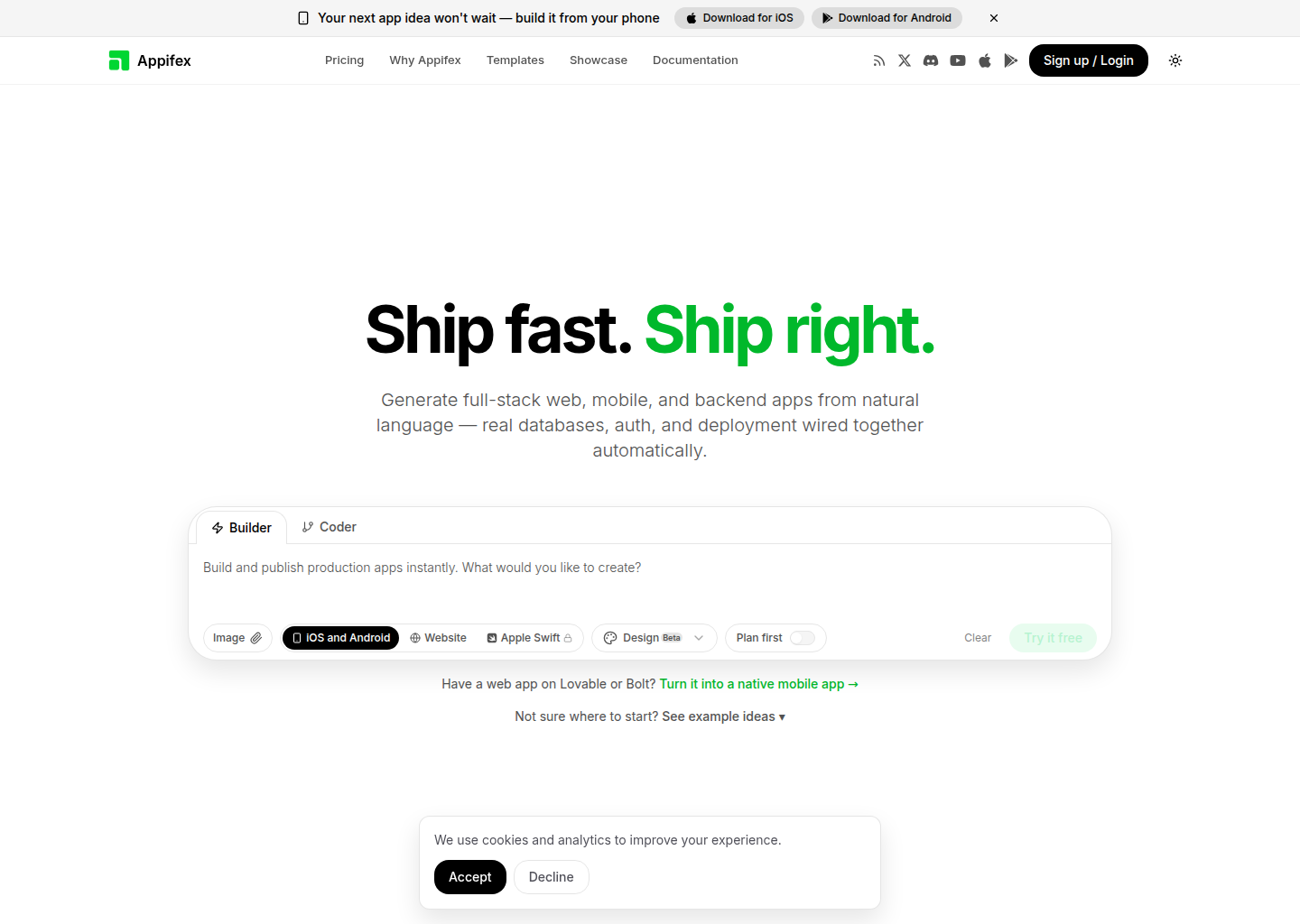
Prompt-driven app builder that generates real web, mobile, and backend code with previews, GitHub sync, built-in editing, and AI-assisted error recovery.
Appifex: A Windsurf alternative for developers who want one prompt-driven workflow for full-stack web apps, native mobile apps, and backend services with GitHub ownership
Appifex is a AI app builder developed by Appifex AI Technologies, Inc.. Prompt-driven app builder that generates real web, mobile, and backend code with previews, GitHub sync, built-in editing, and AI-assisted error recovery. As a Windsurf alternative, it fits developers who want one prompt-driven workflow for full-stack web apps, native mobile apps, and backend services with GitHub ownership.
Appifex vs. Windsurf: Quick Comparison
| Appifex | Windsurf | |
|---|---|---|
| Type | AI app builder | AI IDE |
| IDEs / surface | Browser workspace, built-in code editor, GitHub sync, and CLI access | Standalone / editor-centric workflow |
| Pricing | The homepage meta description says Appifex is free to start, and the public docs describe a live preview plus GitHub-backed ownership workflow. | Not publicly documented in this listing |
| Models | Official documentation describes natural-language generation and integrations, but does not publish one stable public model or context-window matrix | Not publicly documented in this listing |
| Privacy / hosting | Cloud builder with code saved to GitHub; self-hosting of the platform is not publicly documented on accessible official pages | Not publicly documented in this listing |
| Open source | No | No |
Key Strengths
- Real code ownership instead of a sealed output: Appifex's public docs repeatedly stress that generated code is saved to GitHub and can be edited in Appifex or in the user's own IDE. That is a real differentiator from builder products that keep the long-term app life almost entirely inside hosted UI abstractions.
- One workflow across web, mobile, and backend: The official docs do not pitch Appifex as only a frontend toy. They explicitly show web, mobile, backend, and full-stack prompts, which makes it more credible for developers who want one generation loop across the whole application surface instead of a narrower web-only story.
- Better fit for shipping beyond the first demo: Instant previews, code editing, AI error recovery, database and payments integrations, and GitHub sync all point to a product that wants to survive past the first wow moment. That gives Appifex a stronger case than many app builders that generate a nice screen but leave the engineering follow-through ambiguous.
Known Limitations
- Public pricing clarity is weaker than the product narrative: The product story is easy to understand, but the accessible public pricing pages were less transparent during this run than the docs and homepage messaging. Teams comparing budget line by line may need a second pass before standardizing on it.
- Still a builder platform, not an IDE-first coding surface: Appifex gives you real code and GitHub continuity, but it is still centered on prompt-led app generation rather than on the editor-native multi-file coding loop that makes Windsurf attractive for everyday software engineering.
- Best value appears when you actually need full-stack generation: If the team only wants a coding copilot inside an existing repository, Appifex can feel like more platform than necessary. Its strongest case appears when web, backend, and mobile scope are part of the requirement rather than an optional future add-on.
Best For
Appifex is best for developers, founders, and technical operators who want a stronger app-builder story than Windsurf offers. It becomes especially compelling when the project needs frontend, backend, and native mobile output in one place and the buyer still cares about keeping the generated code in GitHub.
It is a weaker fit for teams whose real job is day-to-day coding inside an existing repository. Windsurf stays cleaner when the buyer wants an AI coding environment first and an app-builder platform second.
Pricing
- Free to start: The homepage meta description says Appifex is free to start, and the public docs describe a live preview plus GitHub-backed ownership workflow.
- Tier details: An exact public tier matrix was not clearly exposed in the accessible pricing fetch during this run, so the plan breakdown is treated as not publicly documented.
- Operating costs: Actual app costs still depend on what infrastructure, stores, and connected services the final project uses after generation.
Prices are subject to change. Check the official pricing page for current details.
Tech Details
- Type: AI app builder
- IDEs: Browser workspace, built-in code editor, GitHub sync, and CLI access
- Key features: full-stack code generation, native mobile generation, backend scaffolding, GitHub sync, instant previews, built-in editor, AI error recovery, payments and auth integrations
- Privacy / hosting: Cloud builder with code saved to GitHub; self-hosting of the platform is not publicly documented on accessible official pages
- Models / context window: Official documentation describes natural-language generation and integrations, but does not publish one stable public model or context-window matrix
Workflow Fit
Appifex fits teams that want to begin with a product concept and quickly turn it into something deployable across multiple surfaces. The official docs clearly position it around describing the app, getting code plus infrastructure, previewing instantly, then refining toward production.
That makes Appifex feel closer to a full-stack builder than to an AI IDE. Developers who actually need a day-to-day coding copilot may still prefer Windsurf because it stays closer to the routine of editing and reasoning inside codebases rather than generating app structure from scratch.
When to Choose This Over Windsurf
- Choose Appifex when the project needs a real full-stack builder with web, backend, and mobile output from one prompt-driven workflow.
- Choose Appifex when GitHub ownership matters more than staying inside a managed AI IDE.
- Choose Appifex when instant previews, backend generation, and native-app scope are more important than editor-native coding ergonomics.
When Windsurf May Be a Better Fit
- Windsurf is a better fit when the team wants an AI coding environment for existing repositories instead of a broader app-generation platform.
- Windsurf is a better fit when editor-centered workflow and iterative coding inside a repo matter more than app-builder breadth.
- Windsurf is a better fit when the project does not need native mobile generation or managed full-stack scaffolding from the outset.
Evaluation Questions Before You Choose
Ask whether the bottleneck is writing code inside an existing project or getting a whole application scaffolded across web, backend, and mobile. Appifex is stronger in the second case; Windsurf is usually stronger in the first.
Also ask how important GitHub ownership is compared with IDE-native flow. Appifex makes a clear ownership promise, but it still asks the team to adopt a builder-shaped workflow.
Implementation and Adoption Notes
The most important implementation question is whether the team actually needs an app-generation platform or whether it mostly needs stronger coding help inside an existing repository. Appifex becomes more compelling when the app itself needs to be scaffolded or regenerated, not only when code quality needs to improve inside a familiar editor workflow.
That distinction matters because teams often compare AI products by headline capability instead of by where the work really happens. If the work starts from a product concept, website, or mobile distribution target, a builder can win. If the work starts inside a codebase that already exists, Windsurf often has the cleaner shape.
Cost and Governance
Cost and governance deserve explicit review because AI builders and AI IDEs hide different tradeoffs. Builder products often collapse hosting, previews, and generation into one experience, but that can create more platform dependence. IDE products usually preserve a more traditional engineering workflow, but can leave more infrastructure and shipping responsibility with the team.
With Appifex, the right choice depends on whether its ownership model matches your long-term plan. Some teams benefit from managed flow or open-source control. Others will decide that Windsurf's tighter AI IDE posture is easier to standardize across everyday engineering work.
Migration Considerations
Switching away from Windsurf should not be judged on a flashy first prompt. The more honest test is to rebuild one real job: a feature prototype, a mobile front end, a website recreation, or a backend-backed app slice, depending on the product. If Appifex reduces meaningful weekly friction there, the alternative is real. If not, the category match was probably superficial.
A second migration question is who owns the result after launch. If the answer is a developer in GitHub, a product builder with code output can make sense. If the answer is an operator inside a hosted builder, that is also valid, but it is a different kind of commitment than adopting an AI IDE.
Conclusion
Appifex is a credible Windsurf alternative for builders who need a broader application-generation platform than an AI IDE can offer. Its real advantage is not merely prompt-to-code novelty, but full-stack scope plus GitHub ownership.
Pick Appifex when web, backend, and native mobile generation matter more than living inside an AI IDE. Stay with Windsurf when coding inside existing repositories is the core job and app-builder breadth is secondary.
Sources
FAQ
Is Appifex free to start?
Yes. The homepage metadata says Appifex is free to start, and the official docs show the product around instant previews and iterative generation from natural language.
Does Appifex generate real code or only a hosted prototype?
It generates real code. The official docs say generated code is saved to GitHub automatically and can be edited in Appifex or deployed elsewhere.
How is Appifex different from Windsurf?
Appifex is broader. It is built around generating full applications across web, mobile, and backend, while Windsurf is more focused on the AI IDE and coding workflow itself.
Who should skip Appifex?
Teams that mainly want an AI coding environment for existing repositories may find Windsurf more direct and lower-friction than adopting a builder platform.