AppStruct
Contact
AppStruct
AI-powered no-code app builder for web, mobile, desktop, and Telegram Mini Apps with prompt-based generation and cross-platform publishing.
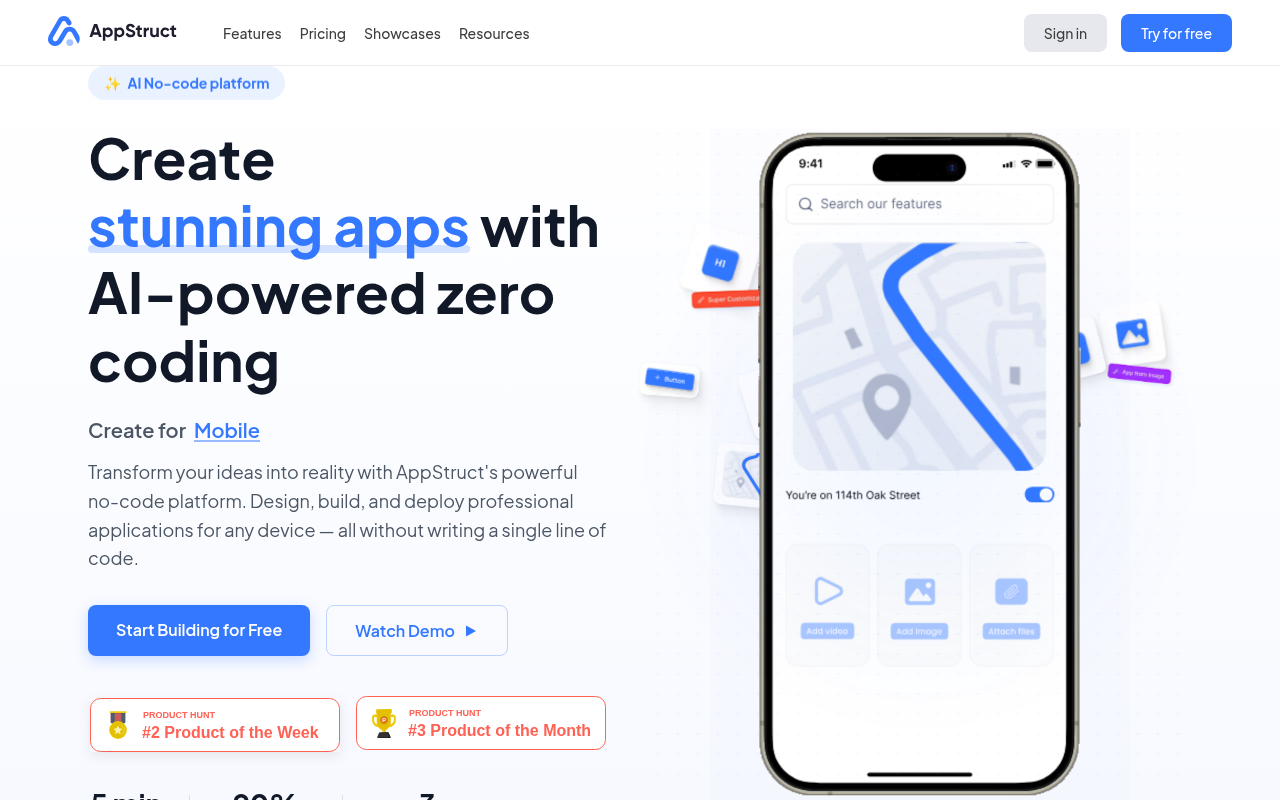
AppStruct: A Windsurf alternative for teams that want one prompt-first builder for web, mobile, desktop, and Telegram Mini Apps rather than an IDE-centered coding workflow
AppStruct is a AI app builder developed by AppStruct. AI-powered no-code app builder for web, mobile, desktop, and Telegram Mini Apps with prompt-based generation and cross-platform publishing. As a Windsurf alternative, it fits teams that want one prompt-first builder for web, mobile, desktop, and Telegram Mini Apps rather than an IDE-centered coding workflow.
AppStruct vs. Windsurf: Quick Comparison
| AppStruct | Windsurf | |
|---|---|---|
| Type | AI app builder | AI IDE |
| IDEs / surface | Managed AI no-code platform that packages one project into web, iOS, Android, desktop, and Telegram Mini App delivery paths | Standalone / editor-centric workflow |
| Pricing | The official public pricing story advertises a free starting tier. | Not publicly documented in this listing |
| Models | The public product story is strong on shipping surfaces and weaker on deep model or context-window disclosure, so exact model details are not publicly documented. | Not publicly documented in this listing |
| Privacy / hosting | The product story is convenience and distribution speed, not source-code export or developer-owned repos, so long-term portability appears weaker than Windsurf's code-oriented posture. | Not publicly documented in this listing |
| Open source | No | No |
Key Strengths
- Multi-surface reach is the core promise: AppStruct is compelling when the goal is not only a web app, but a product that needs web, mobile, desktop, and Telegram distribution from one no-code workflow. That is a broader shipping story than an AI IDE can usually offer.
- Operator-friendly workflow: AppStruct is appealing when founders or operators care more about launch convenience than about maintaining a developer-owned repository from day one. The workflow is shaped around packaging and distribution, not around editor-native coding.
- Telegram relevance: Telegram Mini App support changes the buyer journey because it lets teams meet users where they already are. That makes AppStruct more decision-relevant for Telegram-first businesses than many alternatives that stop at browser output.
Known Limitations
- Weaker code-forward future: AppStruct is weaker than Windsurf if code ownership, GitHub continuity, or later engineering handoff are strategic requirements rather than nice-to-haves.
- Managed-platform tradeoff: Once web, mobile, desktop, and Telegram delivery all run through one platform, moving away later becomes a bigger operational decision than switching a simple web builder.
- Over-scoped for simple web MVPs: If your product only needs a web MVP, AppStruct can feel over-scoped because part of the value proposition is cross-platform packaging you may never use.
Best For
AppStruct is best for non-technical founders, agencies, Telegram-first businesses, mobile-first startups, and small teams that want one builder for web plus app-store style distribution without a developer workflow.
It is less ideal for teams that already know the app should evolve into a developer-owned codebase. In that case, Windsurf keeps a cleaner path toward code-centric engineering habits.
Pricing
- Free: The official public pricing story advertises a free starting tier.
- Standard: The official pricing page exposes Standard at $54 per month, with yearly pricing also shown through structured data.
- Professional: The same pricing sources expose Professional at $86 per month, with annual pricing and yearly savings also advertised.
Prices are subject to change. Check the official pricing page for current details.
Tech Details
- Type: AI app builder
- IDEs: Managed AI no-code platform that packages one project into web, iOS, Android, desktop, and Telegram Mini App delivery paths
- Key features: prompt-first app generation, cross-platform publishing, Telegram Mini Apps, no-code editing, mobile output, desktop output, web deployment
- Privacy / hosting: The product story is convenience and distribution speed, not source-code export or developer-owned repos, so long-term portability appears weaker than Windsurf's code-oriented posture.
- Models / context window: The public product story is strong on shipping surfaces and weaker on deep model or context-window disclosure, so exact model details are not publicly documented.
Workflow Fit
Compared with Windsurf, AppStruct feels more distribution-oriented than code-oriented. It suits teams that define success as getting a usable app live across several customer surfaces quickly, even if that means staying inside a more managed platform.
It is less ideal when the team wants the AI builder to be the first step toward a more custom engineering roadmap rather than the permanent home of the product.
When to Choose This Over Windsurf
- Choose AppStruct over Windsurf when you need one no-code builder to cover web, mobile, desktop, and Telegram from the same product idea.
- Choose it when the people launching the app care more about distribution speed than about code repos.
- Choose it when Telegram Mini Apps or mobile-store presence are part of the go-to-market plan from the start.
When Windsurf May Be a Better Fit
- Windsurf is a better fit when the project is mainly a web product and long-term engineering flexibility matters more than shipping to several surfaces.
- Windsurf is a better fit when developer handoff, custom front-end control, or code-oriented evolution is part of the roadmap from day one.
- Windsurf is a better fit when you want an AI coding environment first and app-builder breadth second.
Evaluation Questions Before You Choose
Ask whether the product truly needs web plus mobile plus desktop plus Telegram from one managed builder, or whether a web-first code-oriented workflow would be enough.
Also ask whether shipping breadth is more valuable than a future with cleaner developer ownership and repo-native iteration.
Implementation and Adoption Notes
The most important implementation question is whether the team actually needs an app-generation platform or whether it mostly needs stronger coding help inside an existing repository. AppStruct becomes more compelling when the app itself needs to be scaffolded or regenerated, not only when code quality needs to improve inside a familiar editor workflow.
That distinction matters because teams often compare AI products by headline capability instead of by where the work really happens. If the work starts from a product concept, mobile distribution target, or broader app package, a builder can win. If the work starts inside a codebase that already exists, Windsurf often has the cleaner shape.
Cost and Governance
Cost and governance deserve explicit review because AI builders and AI IDEs hide different tradeoffs. Builder products often collapse hosting, previews, and generation into one experience, but that can create more platform dependence. IDE products usually preserve a more traditional engineering workflow, but can leave more infrastructure and shipping responsibility with the team.
With AppStruct, the right choice depends on whether its ownership model matches your long-term plan. Some teams benefit from managed flow. Others will decide that Windsurf's tighter AI IDE posture is easier to standardize across everyday engineering work.
Migration Considerations
Switching away from Windsurf should not be judged on a flashy first prompt. The more honest test is to rebuild one real job: a feature prototype, a mobile front end, or a backend-backed app slice, depending on the product. If AppStruct reduces meaningful weekly friction there, the alternative is real. If not, the category match was probably superficial.
A second migration question is who owns the result after launch. If the answer is a developer in GitHub, a product builder can still make sense. If the answer is an operator inside a hosted builder, that is also valid, but it is a different kind of commitment than adopting an AI IDE.
Team Adoption
Team adoption depends less on demo quality and more on who can safely operate the workflow every day. AppStruct is more likely to stick when the same people who define requirements can also review generated output, publish changes, and understand the platform's constraints without always waiting for a developer handoff.
That is a different adoption pattern from Windsurf. Windsurf usually assumes the engineering team stays in control because the work remains inside an IDE-shaped environment. AppStruct can widen participation, but that only helps if the team also agrees on review rules, ownership boundaries, and when a generated result still needs manual correction.
Operational Tradeoffs
Operationally, the choice is not only about speed. It is also about where quality control moves. A builder can remove setup friction and compress several launch steps into one flow, but it also shifts risk into platform assumptions, pricing rules, and product-specific abstractions that are not always obvious during the first hour of use.
That is why a serious evaluation should track weekly behavior instead of only one successful prototype. Teams should measure how easy it is to revise a generated app, recover from wrong output, compare changes over time, and decide when the workflow should leave the builder and move into a more traditional engineering process.
Long-Term Fit
Long-term fit usually depends on whether the tool still helps after the novelty of generation wears off. Some products feel strong at the start because they erase setup and produce a quick visible result, but they lose appeal once teams need repeatability, clearer governance, and a predictable way to move work forward every week.
AppStruct deserves a real pilot only if its strongest public advantages still matter after that novelty window. If those advantages align with the team's repeated jobs, it can be a durable Windsurf alternative. If they do not, the better answer is often to stay with the AI IDE and solve the problem closer to the codebase.
Conclusion
AppStruct is a strong Windsurf alternative for teams that need one prompt-first builder to ship across web, mobile, desktop, and Telegram without touching code.
Pick AppStruct when launch breadth matters more than IDE-native coding. Stay with Windsurf when the app should evolve through developer-owned repository work.
Sources
FAQ
Is AppStruct free?
Yes. The official site publicly advertises a free starting tier.
Who should choose AppStruct over Windsurf?
Founders and operators who need one no-code builder for web, mobile, desktop, and Telegram Mini Apps.
What is the biggest advantage?
Cross-platform reach. AppStruct is more relevant when one product has to ship across several customer surfaces quickly.
What is the main downside?
Portability. You gain launch breadth and convenience, but not the same confidence around code-oriented ownership or developer handoff.