
Appy Pie AI App Generator
Contact
Appy Pie AI App Generator
Prompt-to-app builder that turns plain-English ideas into native Android and iOS apps with backend and hosting included, plus visual editing and store-publishing support.
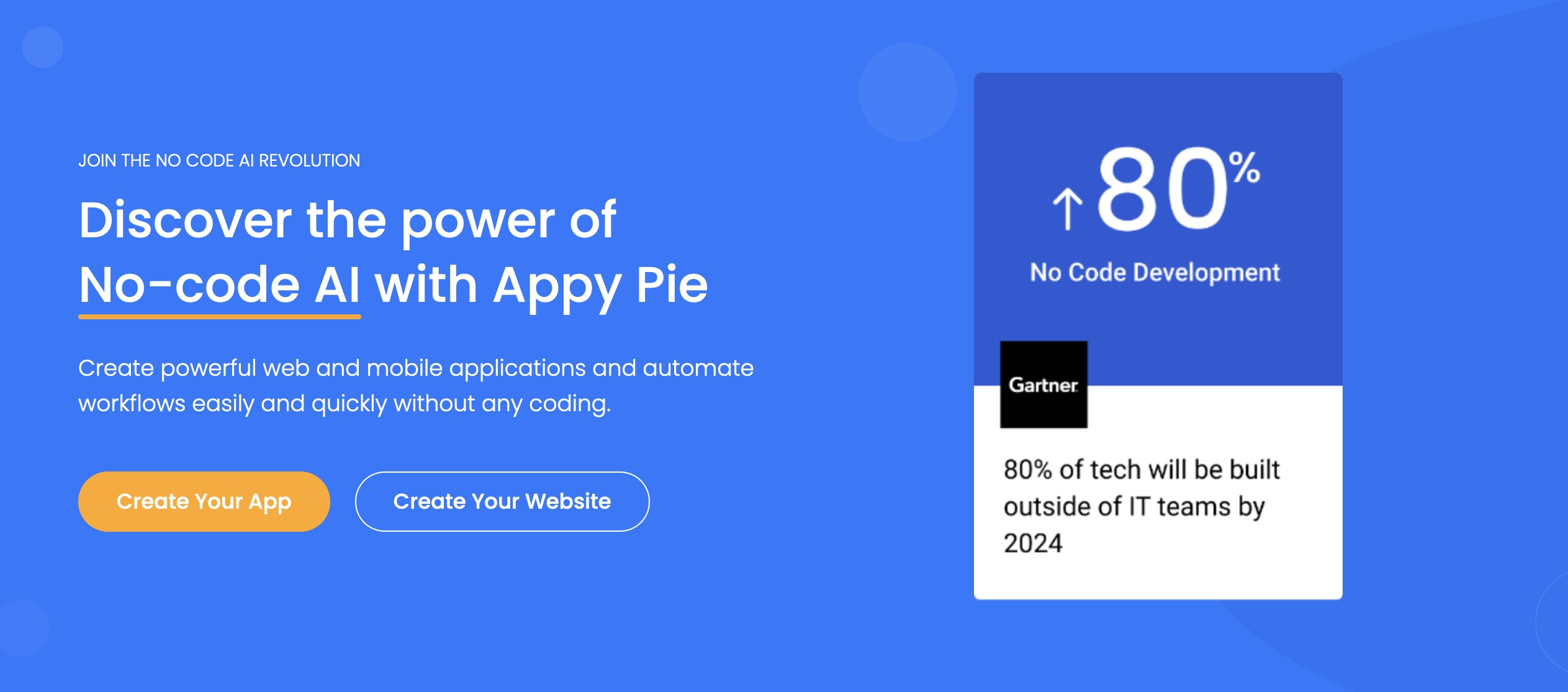
Appy Pie AI App Generator: A Windsurf alternative for builders who need native Android and iOS output quickly, with backend and app-store publishing support, rather than an IDE-native coding workflow
Appy Pie AI App Generator is a AI app builder developed by Appy Pie. Prompt-to-app builder that turns plain-English ideas into native Android and iOS apps with backend and hosting included, plus visual editing and store-publishing support. As a Windsurf alternative, it fits builders who need native Android and iOS output quickly, with backend and app-store publishing support, rather than an IDE-native coding workflow.
Appy Pie AI App Generator vs. Windsurf: Quick Comparison
| Appy Pie AI App Generator | Windsurf | |
|---|---|---|
| Type | AI app builder | AI IDE |
| IDEs / surface | Hosted visual editor rather than IDE-first workflow; Git repository export is not part of the public product story | Standalone / editor-centric workflow |
| Pricing | The official AI App Generator page says users can build, preview, and iterate for free. | Not publicly documented in this listing |
| Models | Official pages describe prompt-based generation and customization, but do not publish a detailed public model or context-window matrix | Not publicly documented in this listing |
| Privacy / hosting | Hosted platform; generated apps run on Appy Pie infrastructure and public FAQ says users do not receive a Git repo export | Not publicly documented in this listing |
| Open source | No | No |
Key Strengths
- Native mobile output is central, not incidental: Appy Pie openly positions the product around native Android and iOS delivery, not only around generating a web app mockup. That makes it a more honest Windsurf alternative for teams whose real job is to ship a mobile product quickly rather than to improve coding throughput inside an IDE.
- Much easier for non-engineers than an AI IDE: The product keeps the workflow in plain language plus a visual editor. That matters because many founders and operators exploring 'vibe coding' do not actually want to live in a coding tool at all; they want a faster path to a shippable app with backend, hosting, and store submission already handled.
- Public story is very concrete about distribution: The official FAQ covers native binaries, app-store submission timelines, backend inclusion, and the difference from web-first builders. That gives Appy Pie a more grounded go-to-market story than many AI app generators that avoid specifics once the conversation reaches shipping details.
Known Limitations
- No Git repo or code-export story: The official FAQ explicitly says you do not get a Git repo, which is a major tradeoff for developers comparing it with tools that promise stronger ownership and portability.
- Weaker fit for ongoing software-engineering workflows: Appy Pie is strongest when the goal is to get a native app live, not when the goal is to work daily inside codebases with an AI assistant. Windsurf still wins the pure coding-workflow comparison for many teams because that is what it is built for.
- Platform lock-in is a real trade: The speed comes from hosted infrastructure, managed publishing flow, and a visual builder. That convenience is valuable, but it also means the long-term app life stays much closer to the platform than to a developer-owned repository.
Best For
Appy Pie AI App Generator is best for founders, operators, and small teams who want a native mobile app fast and are happy to trade code ownership for speed, publishing help, and a managed backend. It is especially useful when the business needs an app in stores more than it needs an IDE-centered developer workflow.
It is a weaker fit for engineering teams whose real goal is to code faster inside existing repositories. Windsurf stays more relevant there because its value centers on coding flow rather than managed app-building.
Pricing
- Free to build: The official AI App Generator page says users can build, preview, and iterate for free.
- Paid publishing: The same official page says publishing to the App Store and Google Play requires a paid plan starting at $16 per month, with a 7-day free trial on paid tiers.
- Builder plans: The public pricing page shows mobile-app plans with tiered Android and broader plan options, while the AI app generator page emphasizes the $16 per month paid entry point for store publishing.
Prices are subject to change. Check the official pricing page for current details.
Tech Details
- Type: AI app builder
- IDEs: Hosted visual editor rather than IDE-first workflow; Git repository export is not part of the public product story
- Key features: text-prompt generation, native Android and iOS output, backend and hosting included, visual editing, store publishing support, push notifications, payments, multilingual prompts
- Privacy / hosting: Hosted platform; generated apps run on Appy Pie infrastructure and public FAQ says users do not receive a Git repo export
- Models / context window: Official pages describe prompt-based generation and customization, but do not publish a detailed public model or context-window matrix
Workflow Fit
Appy Pie fits teams that measure success by how quickly an app reaches users in the stores. The official pages are very direct about prompt input, native binaries, backend included, and 24-48 hour review windows, which makes the workflow much more shipping-oriented than coding-oriented.
That also means Appy Pie is not a substitute for an AI IDE in the strict sense. It solves a different problem: fast app creation and publishing with less engineering ownership. Teams that need the latter more than the former are better served by Windsurf.
When to Choose This Over Windsurf
- Choose Appy Pie when native Android and iOS delivery is the real goal and app-store publishing support matters immediately.
- Choose Appy Pie when the team wants backend, hosting, and visual customization without assembling a code-heavy toolchain.
- Choose Appy Pie when the maintainer after launch is more likely to be an operator than a developer living in an IDE.
When Windsurf May Be a Better Fit
- Windsurf is a better fit when the team wants an AI coding environment rather than a managed app builder.
- Windsurf is a better fit when code ownership and repository-native iteration matter more than mobile-app publishing convenience.
- Windsurf is a better fit when the product is primarily a software-engineering project instead of a fast no-code mobile launch.
Evaluation Questions Before You Choose
Ask whether the main challenge is shipping a mobile app or accelerating engineers inside repositories. Appy Pie wins the first comparison more often than the second.
Also ask whether no Git repo is acceptable. If code portability is a hard requirement, Appy Pie becomes much harder to justify versus builder tools with stronger ownership promises or IDE tools like Windsurf.
Implementation and Adoption Notes
The most important implementation question is whether the team actually needs an app-generation platform or whether it mostly needs stronger coding help inside an existing repository. Appy Pie AI App Generator becomes more compelling when the app itself needs to be scaffolded or regenerated, not only when code quality needs to improve inside a familiar editor workflow.
That distinction matters because teams often compare AI products by headline capability instead of by where the work really happens. If the work starts from a product concept, website, or mobile distribution target, a builder can win. If the work starts inside a codebase that already exists, Windsurf often has the cleaner shape.
Cost and Governance
Cost and governance deserve explicit review because AI builders and AI IDEs hide different tradeoffs. Builder products often collapse hosting, previews, and generation into one experience, but that can create more platform dependence. IDE products usually preserve a more traditional engineering workflow, but can leave more infrastructure and shipping responsibility with the team.
With Appy Pie AI App Generator, the right choice depends on whether its ownership model matches your long-term plan. Some teams benefit from managed flow or open-source control. Others will decide that Windsurf's tighter AI IDE posture is easier to standardize across everyday engineering work.
Migration Considerations
Switching away from Windsurf should not be judged on a flashy first prompt. The more honest test is to rebuild one real job: a feature prototype, a mobile front end, a website recreation, or a backend-backed app slice, depending on the product. If Appy Pie AI App Generator reduces meaningful weekly friction there, the alternative is real. If not, the category match was probably superficial.
A second migration question is who owns the result after launch. If the answer is a developer in GitHub, a product builder with code output can make sense. If the answer is an operator inside a hosted builder, that is also valid, but it is a different kind of commitment than adopting an AI IDE.
Conclusion
Appy Pie AI App Generator is a credible Windsurf alternative only when the buyer really wants an app builder, especially for native mobile output, and not an AI coding environment. Its strongest argument is shipping convenience rather than developer control.
Pick Appy Pie when mobile distribution, backend inclusion, and speed to a working app outweigh code portability. Stay with Windsurf when the team needs a stronger coding workflow and repository-centered control.
Sources
FAQ
Is Appy Pie AI App Generator free?
You can build, preview, and iterate for free. The official AI App Generator page says paid plans starting at $16 per month are required for store publishing.
Does Appy Pie create real native apps?
Yes. The public FAQ says the output is real native Android and iOS binaries rather than only a web wrapper.
Can I export the code from Appy Pie?
No. The official FAQ says generated apps run on Appy Pie infrastructure and users do not get a Git repo.
Who should avoid Appy Pie as a Windsurf alternative?
Developers who want code ownership or an IDE-native AI coding workflow should usually prefer Windsurf or another code-forward tool.