CatDoes
Contact
CatDoes
AI app builder that generates mobile apps, websites, backend services, and app-store-ready output from a prompt-driven workflow.
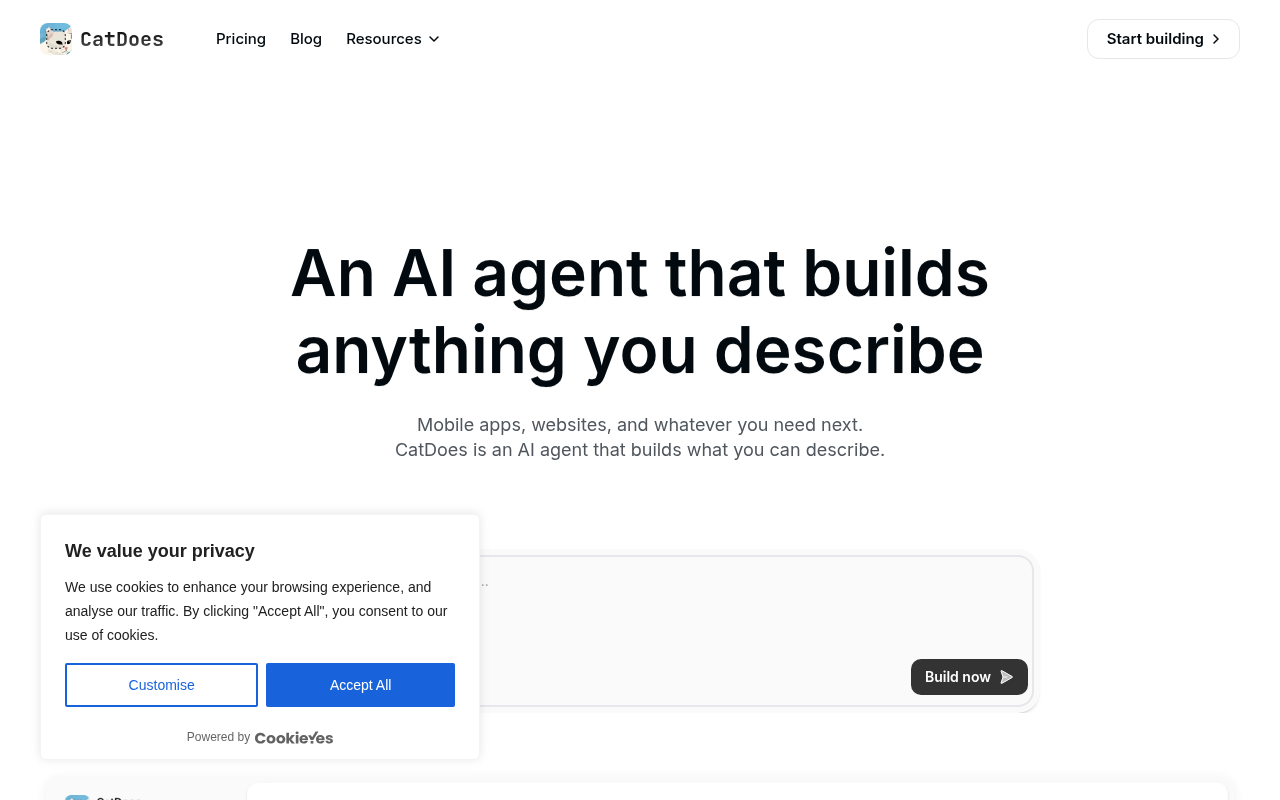
CatDoes: A Windsurf alternative for builders who want one AI-guided workflow for web plus mobile app creation instead of staying inside an editor-centered coding environment
CatDoes is a AI app builder developed by CatDoes. AI app builder that generates mobile apps, websites, backend services, and app-store-ready output from a prompt-driven workflow. As a Windsurf alternative, it fits builders who want one AI-guided workflow for web plus mobile app creation instead of staying inside an editor-centered coding environment.
CatDoes vs. Windsurf: Quick Comparison
| CatDoes | Windsurf | |
|---|---|---|
| Type | AI app builder | AI IDE |
| IDEs / surface | Browser-based app builder with autonomous cloud agent, mobile and web output, and managed backend services | Standalone / editor-centric workflow |
| Pricing | The official pricing page confirms a Free plan at $0 with 25 credits for evaluation. | Not publicly documented in this listing |
| Models | Official public pages emphasize output and workflow more than a stable public model matrix. | Not publicly documented in this listing |
| Privacy / hosting | Hosted cloud builder with managed backend and deployment path. The workflow is more managed than a self-hosted engineering stack. | Not publicly documented in this listing |
| Open source | No | No |
Key Strengths
- Clear mobile story: CatDoes has a stronger mobile angle than most Windsurf alternatives because it explicitly aims to ship iOS, Android, and web products from one guided flow. That makes it relevant when app-store output matters from the start.
- Bundled infrastructure scope: Backend setup, cloud execution, and release positioning are treated as part of the workflow instead of being left as separate engineering chores. This is useful for product builders who want fewer moving parts than a repo-first setup.
- Autonomous-builder posture: The public messaging makes it clear that CatDoes is trying to act more like an app production system than a visual toy. That helps it qualify as a serious AI app builder rather than a thin prompt wrapper.
Known Limitations
- More opinionated than an AI IDE: CatDoes trades stack freedom for guided speed. That is useful for launch-focused teams, but weaker for engineers who want low-level control inside normal coding workflows.
- Credit-shaped cost model: Hosted-platform economics add cost uncertainty because heavy iteration or repeated generation loops can make the effective cost feel different from the headline monthly plan.
- Not a clean replacement for codebase work: Teams that mainly want help with existing codebases, tests, refactors, and review loops will usually get a better fit from Windsurf or another IDE-native assistant.
Best For
CatDoes is best for builders who care specifically about launching mobile and web apps from one AI-guided environment. It works well when the comparison is between coding less and shipping more, not merely between one coding assistant and another.
It is especially relevant for founders and product teams who want app-store-oriented output, backend support, and browser-led generation. In that buying context, it is more honest to compare CatDoes with app builders than with autocomplete tools alone.
Pricing
- Free: The official pricing page confirms a Free plan at $0 with 25 credits for evaluation.
- Core to Plus: The same page lists Core at $17 per month, Starter at $42 per month, and Plus at $84 per month.
- Pro and Max: Higher tiers continue with Pro at $168 per month and Max at $399 per month for heavier usage.
Prices are subject to change. Check the official pricing page for current details.
Tech Details
- Type: AI app builder
- IDEs: Browser-based app builder with autonomous cloud agent, mobile and web output, and managed backend services
- Key features: mobile app generation, website generation, backend setup, app-store release support, React Native Expo output, multi-page canvas, cloud agent workflows
- Privacy / hosting: Hosted cloud builder with managed backend and deployment path. The workflow is more managed than a self-hosted engineering stack.
- Models / context window: Official public pages emphasize output and workflow more than a stable public model matrix.
Workflow Fit
CatDoes fits teams that want to launch products, not just edit code faster. It is strongest when the buyer wants app-store ambition, browser-led generation, and managed backend support in one place.
It is weaker when the team already knows its daily work belongs inside a codebase, shell, and editor workflow. In that case, Windsurf keeps the center of gravity closer to real engineering routines.
When to Choose This Over Windsurf
- Choose CatDoes over Windsurf when the primary goal is launching a mobile or web product from prompts with managed backend and release support.
- Choose it when the team values a guided cloud-agent workflow more than a code-centric workflow inside an editor.
- Choose it when shipping speed across app surfaces matters more than preserving repository-native engineering habits from the first day.
When Windsurf May Be a Better Fit
- Windsurf is a better fit when the team mainly wants faster coding, refactors, debugging, and review assistance inside an AI IDE.
- Windsurf is a better fit when the project already exists as a codebase and app-builder breadth would be more platform than necessary.
- Windsurf is a better fit when low-level stack control matters more than one managed builder for web plus mobile output.
Evaluation Questions Before You Choose
Ask whether the dominant workflow is shipping a new mobile-capable product from prompts or accelerating engineering work inside an existing repository.
Also ask whether a guided builder with backend and release flows removes real friction, or whether it would only add a second platform around work that should stay in code.
Implementation and Adoption Notes
The most important implementation question is whether the team actually needs an app-generation platform or whether it mostly needs stronger coding help inside an existing repository. CatDoes becomes more compelling when the app itself needs to be scaffolded or regenerated, not only when code quality needs to improve inside a familiar editor workflow.
That distinction matters because teams often compare AI products by headline capability instead of by where the work really happens. If the work starts from a product concept, mobile distribution target, or broader app package, a builder can win. If the work starts inside a codebase that already exists, Windsurf often has the cleaner shape.
Cost and Governance
Cost and governance deserve explicit review because AI builders and AI IDEs hide different tradeoffs. Builder products often collapse hosting, previews, and generation into one experience, but that can create more platform dependence. IDE products usually preserve a more traditional engineering workflow, but can leave more infrastructure and shipping responsibility with the team.
With CatDoes, the right choice depends on whether its ownership model matches your long-term plan. Some teams benefit from managed flow. Others will decide that Windsurf's tighter AI IDE posture is easier to standardize across everyday engineering work.
Migration Considerations
Switching away from Windsurf should not be judged on a flashy first prompt. The more honest test is to rebuild one real job: a feature prototype, a mobile front end, or a backend-backed app slice, depending on the product. If CatDoes reduces meaningful weekly friction there, the alternative is real. If not, the category match was probably superficial.
A second migration question is who owns the result after launch. If the answer is a developer in GitHub, a product builder can still make sense. If the answer is an operator inside a hosted builder, that is also valid, but it is a different kind of commitment than adopting an AI IDE.
Team Adoption
Team adoption depends less on demo quality and more on who can safely operate the workflow every day. CatDoes is more likely to stick when the same people who define requirements can also review generated output, publish changes, and understand the platform's constraints without always waiting for a developer handoff.
That is a different adoption pattern from Windsurf. Windsurf usually assumes the engineering team stays in control because the work remains inside an IDE-shaped environment. CatDoes can widen participation, but that only helps if the team also agrees on review rules, ownership boundaries, and when a generated result still needs manual correction.
Operational Tradeoffs
Operationally, the choice is not only about speed. It is also about where quality control moves. A builder can remove setup friction and compress several launch steps into one flow, but it also shifts risk into platform assumptions, pricing rules, and product-specific abstractions that are not always obvious during the first hour of use.
That is why a serious evaluation should track weekly behavior instead of only one successful prototype. Teams should measure how easy it is to revise a generated app, recover from wrong output, compare changes over time, and decide when the workflow should leave the builder and move into a more traditional engineering process.
Long-Term Fit
Long-term fit usually depends on whether the tool still helps after the novelty of generation wears off. Some products feel strong at the start because they erase setup and produce a quick visible result, but they lose appeal once teams need repeatability, clearer governance, and a predictable way to move work forward every week.
CatDoes deserves a real pilot only if its strongest public advantages still matter after that novelty window. If those advantages align with the team's repeated jobs, it can be a durable Windsurf alternative. If they do not, the better answer is often to stay with the AI IDE and solve the problem closer to the codebase.
Conclusion
CatDoes is a real Windsurf alternative for product builders who want mobile plus web output from one AI-guided app-building platform.
Choose CatDoes when launch breadth and guided infrastructure matter more than IDE-native coding. Stay with Windsurf when repository-centric engineering remains the real job.
Sources
FAQ
Is CatDoes free?
Yes. The official pricing page shows a Free plan with 25 credits.
What does CatDoes do better than Windsurf?
It is stronger when the goal is shipping web and mobile products from one guided builder instead of accelerating coding inside an editor.
Who should choose CatDoes over Windsurf?
Founders and product teams that want backend, mobile output, and browser-led generation handled in one workflow.
What is the biggest tradeoff?
You gain shipping convenience across app surfaces, but lose some of the low-level repository-native control that makes Windsurf appealing.