Dreamflow
Contact
Dreamflow
Visual AI builder from the FlutterFlow team that combines prompting, visual canvas, code editing, and cross-platform deployment for web and mobile app creation.
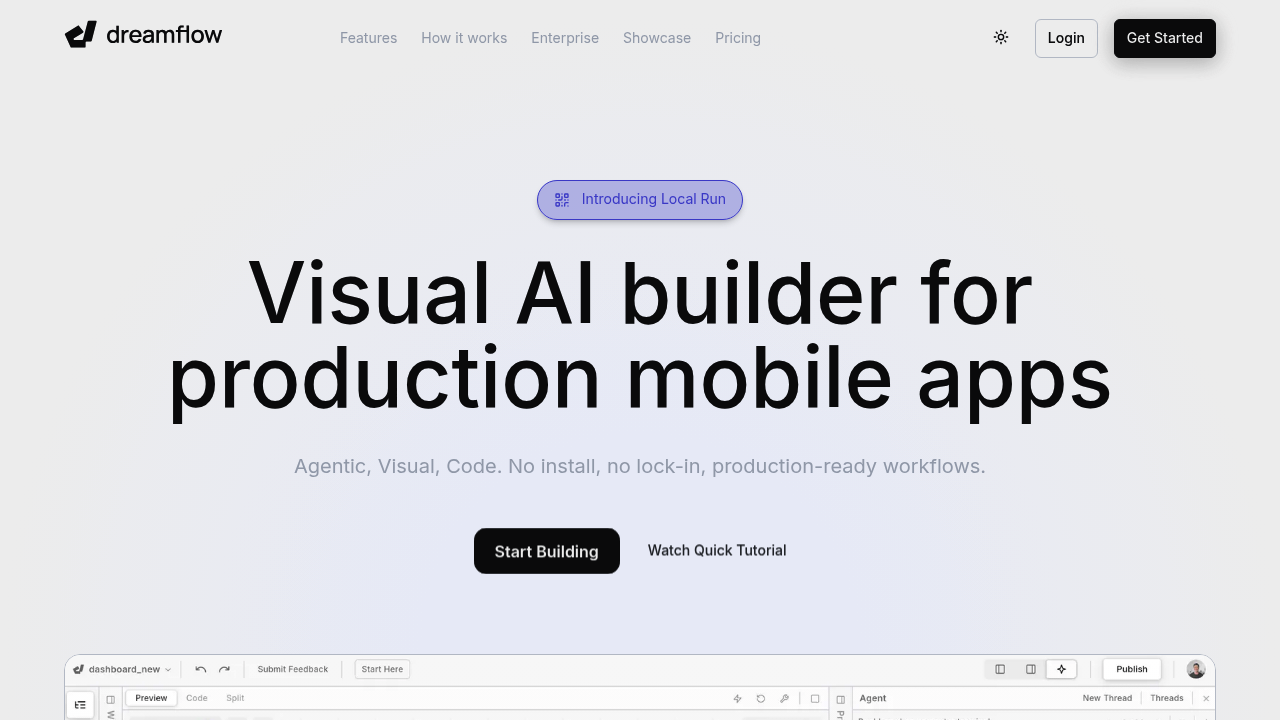
Dreamflow: A Windsurf Alternative for responsive web apps and cross-platform mobile products that benefit from visual editing, code export, and iterative AI scaffolding
Dreamflow is a AI app builder built for founders, designers, product teams, and builders who want one workflow that mixes prompts, visual editing, code access, and cross-platform deployment across web and mobile. As a Windsurf alternative, it is best suited for teams that want responsive web apps and cross-platform mobile products that benefit from visual editing, code export, and iterative AI scaffolding instead of an IDE-first coding workflow.
Dreamflow vs. Windsurf: Quick Comparison
| Dreamflow | Windsurf | |
|---|---|---|
| Type | AI app builder | AI IDE |
| IDEs | Browser-based builder; not an IDE extension; export/import to external code workflows depends on the product | Standalone/editor-centric coding workflow |
| Pricing | Free plan at $0 per month with 10 starter credits and web deployment Hobby starts at $20 per month with full code export and mobile deployment; Pro is $90 per month with Git and premium-model access; Enterprise is custom | Not publicly documented |
| Models | Not publicly documented | Not publicly documented |
| Privacy / hosting | One-click deployment for web on the free tier, with App Store and Play Store deployment on paid plans | Not publicly documented |
| Open source | No | No if treated as product platform |
Key Strengths
- It combines prompt, visual, and code editing in one loop: Lovable is simpler because it keeps the workflow more prompt-first and product-centric. Dreamflow is more flexible when the team wants to move between AI generation, visual adjustments, and direct code control without switching tools.
- It is stronger for cross-platform ambition: Dreamflow can deploy to Web, iOS, and Android, which makes it more attractive when the project is not purely a web MVP. Lovable is usually the cleaner choice when the product is web-only and the team wants less surface-area complexity.
- It offers a more balanced designer-developer bridge: The visual canvas matters. Teams that want a builder where product, design, and code perspectives stay connected may find Dreamflow more collaborative than Lovable, even if it also asks more from the user.
Known Limitations
- Limitation 1: It is less obvious than Lovable for completely non-technical founders who only want the fastest path to one web app.
- Limitation 2: The Flutter and cross-platform orientation can be overkill for teams that do not care about mobile or code-level control.
- Limitation 3: Public pricing is clear, but the jump from $20 Hobby to $90 Pro is meaningful once version control and heavier production workflow become necessary.
Best For
Dreamflow fits teams that judge success by shipping an application surface quickly, keeping product/design discussions close to the build flow, and reducing the amount of raw coding required before a first release. It is usually a better fit for founders, agencies, and product teams that want a managed builder with visible UI output than for engineers who want every step to begin inside an IDE.
The strongest fit appears when the roadmap includes front-end iteration, app delivery, and stakeholder review more than deep repository maintenance. If the team already knows it wants a code-first workflow, this product can still be useful, but its main advantage shrinks quickly.
Pricing
- Free: Free plan at $0 per month with 10 starter credits and web deployment
- Paid: Hobby starts at $20 per month with full code export and mobile deployment; Pro is $90 per month with Git and premium-model access; Enterprise is custom
- Notes: Dreamflow's pricing is refreshingly explicit for a newer AI builder, with clear Free, Hobby, Pro, and Enterprise levels instead of vague usage-only messaging.
Prices are subject to change. Check the official pricing page for current details.
Tech Details
- Type: AI app builder
- IDEs: Browser-based builder; not an IDE extension; export/import to external code workflows depends on the product
- Key features: Context-aware AI generation with iterative edits that stay synced across prompt, visual, and code surfaces, A core differentiator; Dreamflow explicitly sells the combination of AI generation, visual canvas, and code sync, One-click deployment for web on the free tier, with App Store and Play Store deployment on paid plans
- Privacy / hosting: One-click deployment for web on the free tier, with App Store and Play Store deployment on paid plans
- Models / context window: Not publicly documented
When to Choose This Over Windsurf
- Choose Dreamflow when the app may need to ship on web and mobile, not only on the web.
- Choose it when your team wants AI generation plus a real visual canvas and code surface in one synced workflow.
- Choose it when designers and developers both need to touch the product without abandoning the AI-builder loop.
When Windsurf May Be a Better Fit
- Windsurf is a better fit when your work starts from a repository, needs terminal tooling, or demands agentic code edits instead of a managed builder.
- Windsurf stays stronger for debugging, refactoring, and bespoke software engineering that goes beyond the boundaries of a visual app platform.
- Windsurf is also the safer default when the team wants code-first flexibility earlier than this builder naturally offers.
Conclusion
External coverage tends to praise Dreamflow for combining AI speed, visual control, and code-level access in a way that feels more production-aware than many demo-first AI builders. The common caution is complexity: it shines more when the team actually needs that extra breadth.
Dreamflow makes the most sense when the real job is shipping an app experience, not accelerating a terminal-centered engineering loop. If you need repo control, debugging depth, and agentic code edits more than a managed builder, Windsurf remains the more honest choice.
Sources
FAQ
Is Dreamflow a good Lovable alternative?
Yes, especially for cross-platform builders. It is a strong Lovable alternative when you want web plus mobile output and a workflow that combines prompts, visual editing, and code.
Does Dreamflow have a free plan?
Yes. Dreamflow lists a free plan with 10 starter credits and web deployment.
Who should choose Dreamflow over Lovable?
Teams that want visual canvas plus code access, or teams that may deploy to mobile as well as web.
What is the biggest tradeoff?
Complexity. Dreamflow offers more surfaces and power than Lovable, but that can slow down builders who only need a simple web MVP.
Workflow Notes
Dreamflow also changes the working relationship between developers and non-developers. Product managers, founders, and designers can usually contribute earlier because the interface exposes visual state, deployment ideas, and app behavior more directly than an IDE does.
That does not automatically make the platform better. It means the tradeoff should be judged against your team structure: if the project needs shared visibility and faster app iteration, the builder workflow becomes a benefit; if it needs unrestricted engineering control, the same abstraction becomes friction.
Migration Questions Teams Should Ask
Before switching from Windsurf to Dreamflow, the team should decide whether it is replacing a coding workflow or adding a faster app-shipping layer on top of one. That question matters because many disappointments with AI builders come from expecting them to behave like IDE agents once the project grows beyond the initial prototype.
The safest path is usually to define a small product slice, ship it, and then judge how much of the resulting app still belongs inside the builder. If the platform keeps helping after the first launch, it is a good sign; if the team immediately wants lower-level control, Windsurf or another code-first environment should stay central.
Operational Tradeoffs
Dreamflow can reduce setup friction, but it also concentrates more decisions inside one platform. Billing, deployment, collaboration, and data architecture may become easier to start with, yet they can also become more opinionated than a developer-centered IDE workflow.
That is why this comparison should be read as a workflow choice rather than a raw feature race. Windsurf helps teams write and maintain code faster, while Dreamflow helps teams turn product ideas into app surfaces faster. Those are adjacent goals, not identical ones.
Community Signal
External coverage tends to praise Dreamflow for combining AI speed, visual control, and code-level access in a way that feels more production-aware than many demo-first AI builders. The common caution is complexity: it shines more when the team actually needs that extra breadth.
Workflow Notes
Dreamflow also changes the working relationship between developers and non-developers. Product managers, founders, and designers can usually contribute earlier because the interface exposes visual state, deployment ideas, and app behavior more directly than an IDE does.
That does not automatically make the platform better. It means the tradeoff should be judged against your team structure: if the project needs shared visibility and faster app iteration, the builder workflow becomes a benefit; if it needs unrestricted engineering control, the same abstraction becomes friction.
Migration Questions Teams Should Ask
Before switching from Windsurf to Dreamflow, the team should decide whether it is replacing a coding workflow or adding a faster app-shipping layer on top of one. That question matters because many disappointments with AI builders come from expecting them to behave like IDE agents once the project grows beyond the initial prototype.
The safest path is usually to define a small product slice, ship it, and then judge how much of the resulting app still belongs inside the builder. If the platform keeps helping after the first launch, it is a good sign; if the team immediately wants lower-level control, Windsurf or another code-first environment should stay central.
Operational Tradeoffs
Dreamflow can reduce setup friction, but it also concentrates more decisions inside one platform. Billing, deployment, collaboration, and data architecture may become easier to start with, yet they can also become more opinionated than a developer-centered IDE workflow.
That is why this comparison should be read as a workflow choice rather than a raw feature race. Windsurf helps teams write and maintain code faster, while Dreamflow helps teams turn product ideas into app surfaces faster. Those are adjacent goals, not identical ones.
Community Signal
External coverage tends to praise Dreamflow for combining AI speed, visual control, and code-level access in a way that feels more production-aware than many demo-first AI builders. The common caution is complexity: it shines more when the team actually needs that extra breadth.