Flatlogic
Contact
Flatlogic
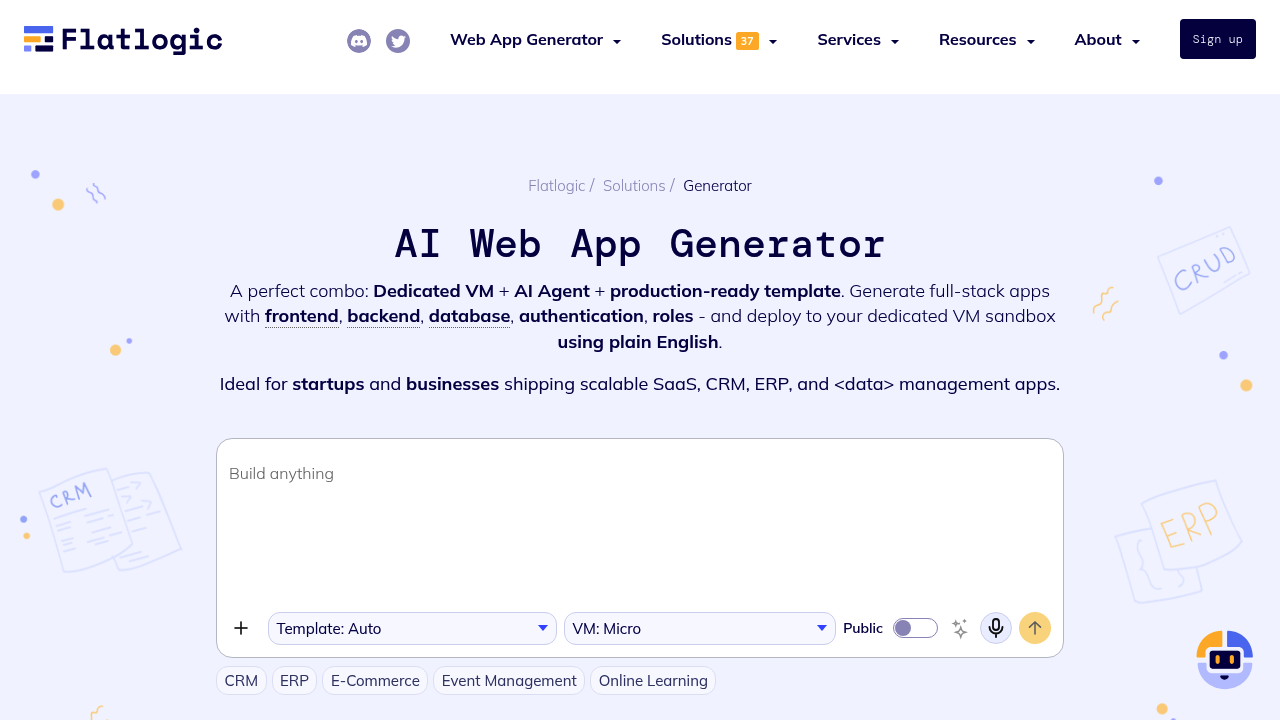
AI web application generator for startups and SMBs that produces full-stack business apps with frontend, backend, database, roles, and hosted VM deployment from plain-English prompts.
Flatlogic: A Windsurf Alternative for full-stack business web apps such as SaaS back offices, internal tools, CRMs, ERPs, and data-heavy operational dashboards
Flatlogic is a AI app builder built for startups, SMBs, agencies, internal-tool builders, and operators who want AI-generated SaaS, CRM, ERP, or dashboard apps with a more explicit backend, database, and deployment story. As a Windsurf alternative, it is best suited for teams that want full-stack business web apps such as SaaS back offices, internal tools, CRMs, ERPs, and data-heavy operational dashboards instead of an IDE-first coding workflow.
Flatlogic vs. Windsurf: Quick Comparison
| Flatlogic | Windsurf | |
|---|---|---|
| Type | AI app builder | AI IDE |
| IDEs | Browser-based builder; not an IDE extension; export/import to external code workflows depends on the product | Standalone/editor-centric coding workflow |
| Pricing | Free plan with 5 credits per month and up to 3 public apps, aimed at testing and prototypes Pro starts at $20 per month with 25 credits, private apps, paid templates, and stable environments; Enterprise is custom-priced | Not publicly documented |
| Models | Not publicly documented | Not publicly documented |
| Privacy / hosting | Dedicated VM deployment and hosted development or stable environments are part of the core offer, not an afterthought | Not publicly documented |
| Open source | No | No if treated as product platform |
Key Strengths
- It starts from software structure, not demo-friendly prompt magic: Flatlogic immediately foregrounds stacks, databases, roles, and hosted environments. That makes it less magical than Lovable in the first five minutes, but often more honest about what production business apps actually need after the screenshot moment passes.
- It treats deployment and source control as part of the product: Lovable is better when the buyer mostly wants a fast product-shaped web app. Flatlogic is stronger when the buyer wants generated software that can be hosted, iterated, and moved closer to a normal engineering workflow.
- It is better suited to admin, workflow, and operations-heavy apps: The examples, templates, and pricing logic all suggest a platform optimized for CRMs, dashboards, portals, and internal business systems. That is a closer match than Lovable when the project is more operations software than brand-forward startup product.
Known Limitations
- Limitation 1: It is less beginner-friendly than Lovable because the product exposes infrastructure and software-delivery decisions earlier in the workflow.
- Limitation 2: The template-plus-credits-plus-hosting model is more cognitively demanding than simpler AI app builders for non-technical founders who only want a polished first release.
- Limitation 3: Visual editing is not the main strength, so teams that care deeply about UI experimentation may feel more friction than in Lovable.
Best For
Flatlogic fits teams that judge success by shipping an application surface quickly, keeping product/design discussions close to the build flow, and reducing the amount of raw coding required before a first release. It is usually a better fit for founders, agencies, and product teams that want a managed builder with visible UI output than for engineers who want every step to begin inside an IDE.
The strongest fit appears when the roadmap includes front-end iteration, app delivery, and stakeholder review more than deep repository maintenance. If the team already knows it wants a code-first workflow, this product can still be useful, but its main advantage shrinks quickly.
Pricing
- Free: Free plan with 5 credits per month and up to 3 public apps, aimed at testing and prototypes
- Paid: Pro starts at $20 per month with 25 credits, private apps, paid templates, and stable environments; Enterprise is custom-priced
- Notes: Flatlogic separates cost into plan price, AI credits, hosting, and template licenses, which makes it more transparent for serious software work but less emotionally simple than Lovable's cleaner consumer-style builder plans.
Prices are subject to change. Check the official pricing page for current details.
Tech Details
- Type: AI app builder
- IDEs: Browser-based builder; not an IDE extension; export/import to external code workflows depends on the product
- Key features: Prompt-to-app generation plus iterative AI modifications on top of a production-ready template and hosted development environment, Limited compared with visual-first builders; the value comes more from generated software structure than from a design-canvas workflow, Dedicated VM deployment and hosted development or stable environments are part of the core offer, not an afterthought
- Privacy / hosting: Dedicated VM deployment and hosted development or stable environments are part of the core offer, not an afterthought
- Models / context window: Not publicly documented
When to Choose This Over Windsurf
- Choose Flatlogic when the app is an internal tool, SaaS back office, CRM, ERP, or dashboard that truly benefits from explicit backend structure.
- Choose it when source-code ownership and GitHub continuity matter more than the easiest first prototype experience.
- Choose it when your team can tolerate a more technical setup in exchange for a clearer route from generated prototype to maintainable software.
When Windsurf May Be a Better Fit
- Windsurf is a better fit when your work starts from a repository, needs terminal tooling, or demands agentic code edits instead of a managed builder.
- Windsurf stays stronger for debugging, refactoring, and bespoke software engineering that goes beyond the boundaries of a visual app platform.
- Windsurf is also the safer default when the team wants code-first flexibility earlier than this builder naturally offers.
Conclusion
External writeups describe Flatlogic as stronger for full-stack business software than for casual prompt experimentation. The upside is structure, code ownership, and deployment honesty; the downside is a steeper learning curve and a more layered cost model.
Flatlogic makes the most sense when the real job is shipping an app experience, not accelerating a terminal-centered engineering loop. If you need repo control, debugging depth, and agentic code edits more than a managed builder, Windsurf remains the more honest choice.
Sources
FAQ
Is Flatlogic a good Lovable alternative?
Yes, especially for structured business apps. It is a stronger Lovable alternative when the project needs real backend structure, roles, databases, and a clearer path to owned code.
Does Flatlogic have a free plan?
Yes. Flatlogic's pricing page shows a free plan with 5 monthly credits and up to 3 public apps.
Who should choose Flatlogic over Lovable?
Teams building internal tools, CRMs, ERPs, or SaaS back offices. It is best when software structure matters more than the smoothest no-code onboarding.
What is the biggest tradeoff?
Complexity. Flatlogic is more transparent about infrastructure and ownership, but that also makes it less beginner-friendly than Lovable.
Workflow Notes
Flatlogic also changes the working relationship between developers and non-developers. Product managers, founders, and designers can usually contribute earlier because the interface exposes visual state, deployment ideas, and app behavior more directly than an IDE does.
That does not automatically make the platform better. It means the tradeoff should be judged against your team structure: if the project needs shared visibility and faster app iteration, the builder workflow becomes a benefit; if it needs unrestricted engineering control, the same abstraction becomes friction.
Migration Questions Teams Should Ask
Before switching from Windsurf to Flatlogic, the team should decide whether it is replacing a coding workflow or adding a faster app-shipping layer on top of one. That question matters because many disappointments with AI builders come from expecting them to behave like IDE agents once the project grows beyond the initial prototype.
The safest path is usually to define a small product slice, ship it, and then judge how much of the resulting app still belongs inside the builder. If the platform keeps helping after the first launch, it is a good sign; if the team immediately wants lower-level control, Windsurf or another code-first environment should stay central.
Operational Tradeoffs
Flatlogic can reduce setup friction, but it also concentrates more decisions inside one platform. Billing, deployment, collaboration, and data architecture may become easier to start with, yet they can also become more opinionated than a developer-centered IDE workflow.
That is why this comparison should be read as a workflow choice rather than a raw feature race. Windsurf helps teams write and maintain code faster, while Flatlogic helps teams turn product ideas into app surfaces faster. Those are adjacent goals, not identical ones.
Community Signal
External writeups describe Flatlogic as stronger for full-stack business software than for casual prompt experimentation. The upside is structure, code ownership, and deployment honesty; the downside is a steeper learning curve and a more layered cost model.
- https://uibakery.io/blog/ai-app-generator-tools
- https://www.noupe.com/magazine/business-online/no-code-ai-app-builders.html
Workflow Notes
Flatlogic also changes the working relationship between developers and non-developers. Product managers, founders, and designers can usually contribute earlier because the interface exposes visual state, deployment ideas, and app behavior more directly than an IDE does.
That does not automatically make the platform better. It means the tradeoff should be judged against your team structure: if the project needs shared visibility and faster app iteration, the builder workflow becomes a benefit; if it needs unrestricted engineering control, the same abstraction becomes friction.
Migration Questions Teams Should Ask
Before switching from Windsurf to Flatlogic, the team should decide whether it is replacing a coding workflow or adding a faster app-shipping layer on top of one. That question matters because many disappointments with AI builders come from expecting them to behave like IDE agents once the project grows beyond the initial prototype.
The safest path is usually to define a small product slice, ship it, and then judge how much of the resulting app still belongs inside the builder. If the platform keeps helping after the first launch, it is a good sign; if the team immediately wants lower-level control, Windsurf or another code-first environment should stay central.
Operational Tradeoffs
Flatlogic can reduce setup friction, but it also concentrates more decisions inside one platform. Billing, deployment, collaboration, and data architecture may become easier to start with, yet they can also become more opinionated than a developer-centered IDE workflow.
That is why this comparison should be read as a workflow choice rather than a raw feature race. Windsurf helps teams write and maintain code faster, while Flatlogic helps teams turn product ideas into app surfaces faster. Those are adjacent goals, not identical ones.
Community Signal
External writeups describe Flatlogic as stronger for full-stack business software than for casual prompt experimentation. The upside is structure, code ownership, and deployment honesty; the downside is a steeper learning curve and a more layered cost model.