
Open Lovable
Contact
Open Lovable
Open-source AI website builder that turns existing websites into React and Next.js apps with TypeScript and Tailwind, using a self-hostable workflow rather than a managed subscription product.
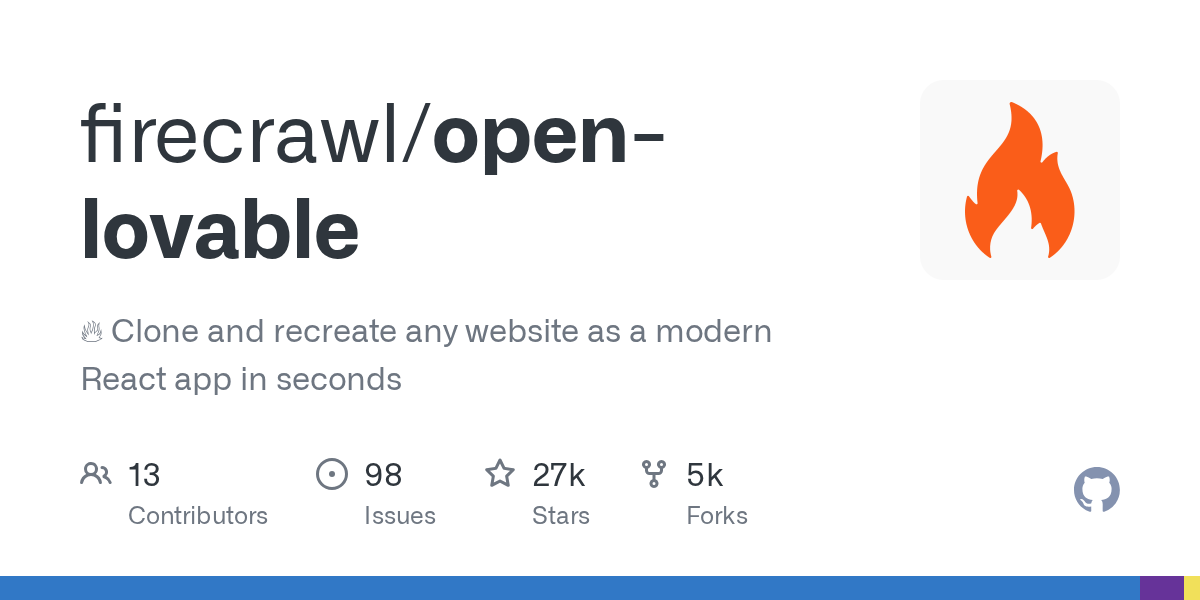
Open Lovable: A Windsurf alternative for developers who want to clone existing websites into editable React and Next.js code instead of working inside a proprietary AI IDE
Open Lovable is a AI app builder developed by Mendable AI. Open-source AI website builder that turns existing websites into React and Next.js apps with TypeScript and Tailwind, using a self-hostable workflow rather than a managed subscription product. As a Windsurf alternative, it fits developers who want to clone existing websites into editable React and Next.js code instead of working inside a proprietary AI IDE.
Open Lovable vs. Windsurf: Quick Comparison
| Open Lovable | Windsurf | |
|---|---|---|
| Type | AI app builder | AI IDE |
| IDEs / surface | GitHub repository, local Node.js workflow, and browser UI rather than a proprietary AI IDE shell | Standalone / editor-centric workflow |
| Pricing | The official site says Open Lovable is 100 percent free, MIT licensed, and has no subscription. | Not publicly documented in this listing |
| Models | The official site names Claude, GPT-4, Groq or Kimi, and Gemini, but does not publish one stable public model or context-window matrix | Not publicly documented in this listing |
| Privacy / hosting | Self-hostable open-source workflow; actual privacy depends on the models and services the user configures | Not publicly documented in this listing |
| Open source | Yes | No |
Key Strengths
- Open source and self-hostable by design: Open Lovable's official site repeatedly emphasizes MIT licensing, no subscription, and full control over the generation process. That gives it a very different ownership profile from Windsurf and other proprietary AI products.
- Strong for cloning and recreation workflows: The core value proposition is transforming an existing website into React or Next.js code in seconds. That is a narrower use case than Windsurf's AI IDE flow, but for teams rebuilding an interface or reverse-engineering structure, it can be more practical than a general coding agent.
- Modern stack output is explicit: The site directly names React, Next.js, TypeScript, Tailwind CSS, Firecrawl, and E2B. That makes the product feel more concrete for developers who care what the output stack actually is instead of accepting a vague 'AI app builder' promise.
Known Limitations
- It is not a general-purpose AI IDE replacement: Open Lovable is optimized around cloning and regenerating UI from existing websites. Teams looking for day-to-day coding assistance, debugging help, and repository reasoning will still find Windsurf more aligned with that job.
- Operational setup is real: The official how-to section requires Node.js plus API keys for scraping, model providers, and execution. That makes it more flexible, but also more demanding than a hosted product where the infrastructure is hidden.
- Great for recreation, less proven for net-new product building: The public site is strongest when it talks about cloning websites into React output. That is useful, but it is a narrower product-building story than a tool that positions itself around creating new software from scratch inside a polished environment.
Best For
Open Lovable is best for developers who want open-source control and have a real website-cloning use case. It makes the most sense when the buyer wants editable React or Next.js code from an existing website and prefers ownership plus extensibility over polished managed convenience.
It is a weaker fit for teams that want a broader AI coding product for everyday repository work. Windsurf remains more natural when the work is coding inside projects rather than cloning interfaces into a new codebase.
Pricing
- Core product: The official site says Open Lovable is 100 percent free, MIT licensed, and has no subscription.
- Usage model: There is no software subscription, but users still need their own API keys for services such as Firecrawl, E2B, and the selected AI model provider.
- Operational costs: Practical cost depends on which scraping, execution, and model services the user plugs into the open-source workflow.
Prices are subject to change. Check the official pricing page for current details.
Tech Details
- Type: AI app builder
- IDEs: GitHub repository, local Node.js workflow, and browser UI rather than a proprietary AI IDE shell
- Key features: website cloning, React and Next.js output, TypeScript, Tailwind CSS, model flexibility, self-hostability, secure code execution, Firecrawl and E2B integration
- Privacy / hosting: Self-hostable open-source workflow; actual privacy depends on the models and services the user configures
- Models / context window: The official site names Claude, GPT-4, Groq or Kimi, and Gemini, but does not publish one stable public model or context-window matrix
Workflow Fit
Open Lovable fits a developer who wants to own the whole process and is comfortable wiring API keys, cloning a repository, and running a local or self-hosted toolchain. For that user, the absence of a subscription and the explicit modern frontend stack are real advantages.
The tradeoff is that Open Lovable solves a narrower problem than Windsurf does. It is strongest when you already have a website to transform; it is less compelling when you simply want an AI-native coding partner for ongoing software engineering.
When to Choose This Over Windsurf
- Choose Open Lovable when the primary task is turning an existing website into editable React or Next.js code.
- Choose Open Lovable when open-source licensing, self-hostability, and workflow control matter more than a polished managed AI product.
- Choose Open Lovable when the team prefers to own the full stack of tools and API keys rather than subscribe to a proprietary IDE workflow.
When Windsurf May Be a Better Fit
- Windsurf is a better fit when the team wants an AI IDE for everyday coding instead of a website-cloning workflow.
- Windsurf is a better fit when onboarding speed and managed product simplicity matter more than self-hosted flexibility.
- Windsurf is a better fit when the project is about building or maintaining software in existing repositories rather than recreating an interface from a URL.
Evaluation Questions Before You Choose
Ask whether the real task is cloning an interface or accelerating coding inside existing repositories. Open Lovable is stronger in the first case; Windsurf is stronger in the second.
Also ask whether the team wants to manage its own API keys and infrastructure dependencies. That control is the upside of Open Lovable, but it also increases setup burden.
Implementation and Adoption Notes
The most important implementation question is whether the team actually needs an app-generation platform or whether it mostly needs stronger coding help inside an existing repository. Open Lovable becomes more compelling when the app itself needs to be scaffolded or regenerated, not only when code quality needs to improve inside a familiar editor workflow.
That distinction matters because teams often compare AI products by headline capability instead of by where the work really happens. If the work starts from a product concept, website, or mobile distribution target, a builder can win. If the work starts inside a codebase that already exists, Windsurf often has the cleaner shape.
Cost and Governance
Cost and governance deserve explicit review because AI builders and AI IDEs hide different tradeoffs. Builder products often collapse hosting, previews, and generation into one experience, but that can create more platform dependence. IDE products usually preserve a more traditional engineering workflow, but can leave more infrastructure and shipping responsibility with the team.
With Open Lovable, the right choice depends on whether its ownership model matches your long-term plan. Some teams benefit from managed flow or open-source control. Others will decide that Windsurf's tighter AI IDE posture is easier to standardize across everyday engineering work.
Migration Considerations
Switching away from Windsurf should not be judged on a flashy first prompt. The more honest test is to rebuild one real job: a feature prototype, a mobile front end, a website recreation, or a backend-backed app slice, depending on the product. If Open Lovable reduces meaningful weekly friction there, the alternative is real. If not, the category match was probably superficial.
A second migration question is who owns the result after launch. If the answer is a developer in GitHub, a product builder with code output can make sense. If the answer is an operator inside a hosted builder, that is also valid, but it is a different kind of commitment than adopting an AI IDE.
Conclusion
Open Lovable is a real Windsurf alternative for developers who care about open-source ownership and website-to-React generation more than IDE-centric coding assistance. Its best argument is control plus a very specific cloning workflow.
Pick Open Lovable when self-hostability, React output, and interface recreation matter more than having an AI IDE. Stay with Windsurf when the core job is coding and reasoning inside software projects rather than regenerating websites.
Sources
FAQ
Is Open Lovable really free?
Yes. The official site says it is 100 percent free, MIT licensed, and has no subscription, though users still need their own API keys for the connected services.
What does Open Lovable do better than Windsurf?
It is better for cloning existing websites into editable React and Next.js code, and for buyers who care about open-source ownership more than a managed AI IDE.
What is the main downside compared with Windsurf?
Open Lovable is not a general-purpose AI IDE and it requires more setup, including external API keys and a local development workflow.
Who should skip Open Lovable?
Teams that mainly want an AI coding environment for daily repository work will usually find Windsurf more direct and better aligned.