Rocket.new
Contact
Rocket.new
AI app builder and product workflow platform for teams that want research, build, and production deployment in one browser workflow.
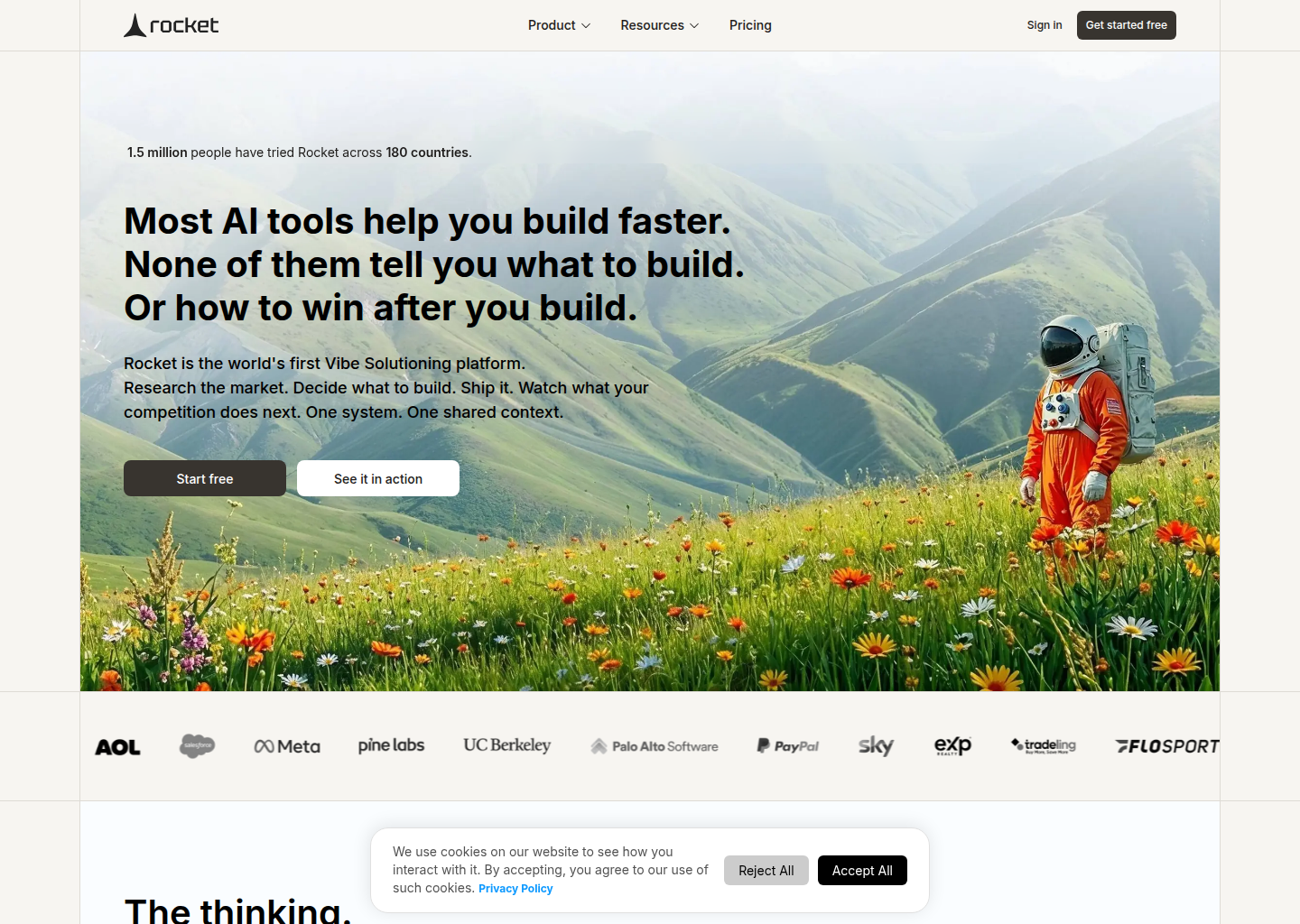
Rocket.new: A Windsurf alternative for founders and product teams who want research, build, and production deployment to happen inside one browser workflow
Rocket.new is a AI app builder developed by Rocket.new. It is best understood as a browser-led product builder rather than an editor-native coding environment. As a Windsurf alternative, it fits founders and product teams who want research, build, and production deployment to happen inside one browser workflow.
Rocket.new vs. Windsurf: Quick Comparison
| Rocket.new | Windsurf | |
|---|---|---|
| Type | Ai App Builder | AI IDE |
| IDEs | Browser-based builder with docs; positioned around web apps, mobile apps, and deployment rather than local IDE plug-ins | Standalone / editor-centric workflow |
| Pricing | 20 one-time credits with no card required according to the public pricing page. | Not publicly documented in this listing |
| Models | Not publicly documented | Not publicly documented in this listing |
| Privacy / hosting | Cloud-hosted browser platform with managed production workflow | Not publicly documented in this listing |
| Open source | No | Not publicly documented in this listing |
Key Strengths
- Broader than a simple prompt-to-UI tool: Rocket.new is trying to cover more of the product loop than many app builders. Its public story combines problem framing, build execution, deployment, and competitive or operational context instead of acting like a single-screen prototype generator. That makes it interesting for teams that want one place to think and ship, not just one place to generate code.
- Production language appears early: The pricing and public materials emphasize staging, production environments, deployable web apps, and even mobile-app language. That changes the buyer signal because the platform is not only promising a demo; it is promising a path to something more operational. For founders who want the AI layer closer to delivery than to experimentation, that is a meaningful difference.
- Clear public paid tiers: Rocket's pricing is unusually direct compared with many AI builders that hide serious usage behind opaque sales motions. A free entry path and visible paid tiers make it easier to test the fit before institutional buy-in. That transparency matters when a team is comparing multiple builders and trying to control evaluation cost.
- Team-friendly framing: Rocket is one of the stronger examples of a product that talks to teams, not only solo tinkerers. Collaboration, governance, and broader workflow language show up early, which makes it easier to imagine the tool inside a cross-functional product cycle instead of as a one-person experiment box.
Known Limitations
- Wider scope can mean more workflow weight: Rocket's bigger product story is not always an advantage. Teams that already know what they want to build may find the research and intelligence layers heavier than necessary. Windsurf can feel calmer when the real need is simply getting inside the code and moving fast there.
- Still less repository-native than an AI IDE: Rocket may help create and ship products, but it is not shaped like a codebase-first environment. If the job is understanding an existing repository, editing across files, and staying close to engineering reality, Windsurf still has the structural advantage. Browser convenience does not erase that difference.
- Credits and managed workflow remain core constraints: Rocket's value proposition assumes teams are comfortable buying into a hosted platform with metered usage logic. That can be perfectly acceptable for early product work, but it also means spend, workflow shape, and platform dependence remain active decisions. An AI IDE is often easier to rationalize when the team already has mature engineering habits.
Best For
Rocket.new is best for startups, product teams, and technical operators who want one surface for ideation, build execution, and deployment. It fits especially well when the team is still deciding what to build and wants the AI system to help narrow the product shape before writing or exporting code.
It is a weaker fit when the problem is not product ambiguity but codebase execution. If a team already knows the repo, the tests, and the architecture are the center of truth, Windsurf is usually the cleaner operational choice.
Pricing
- Free: 20 one-time credits with no card required according to the public pricing page.
- Pro: $25/month.
- Rocket / Booster: $50/month and $250/month for broader production usage and larger credit pools.
Prices are subject to change. Check the official pricing page for current details.
Tech Details
- Type: Ai App Builder
- IDEs: Browser-based builder with docs; positioned around web apps, mobile apps, and deployment rather than local IDE plug-ins
- Key features: prompt-driven product building, research and intelligence layer, staging and production environments, custom domains, connectors, team collaboration, deployment workflow
- Privacy / hosting: Cloud-hosted browser platform with managed production workflow
- Models / context window: Not publicly documented
Workflow Fit
Rocket.new changes the workflow by shifting product definition and delivery into the same managed surface. That can save time when teams otherwise bounce between docs, prototype tools, and deployment layers before anything becomes visible.
The same breadth can create drag if the team is already past that stage. Once a product direction is settled and the repository becomes the real asset, the extra product-intelligence layer can feel less important than a good AI IDE with direct code context.
When to Choose This Over Windsurf
- Choose Rocket.new when you want one browser platform to compress product discovery, app generation, and deployment into a single workflow.
- Choose Rocket.new when staging, production, and non-engineer collaboration matter more than keeping the AI layer inside an IDE.
- Choose Rocket.new when the buyer wants a product-building operating system, not only a repo-aware coding assistant.
When Windsurf May Be a Better Fit
- Windsurf is a better fit when codebase-aware editing and engineering flow are more important than ideation and hosted deployment.
- Windsurf is a better fit when the team already has an established repo and wants the AI to work within that context instead of replacing it with a broader platform.
- Windsurf is a better fit when credit-based browser workflows feel like extra process rather than leverage.
Evaluation Questions Before You Choose
Ask whether your biggest problem is uncertainty before build or execution during build. Rocket shines more in the first case because it explicitly markets thinking-plus-building. Windsurf shines more in the second because it keeps the work close to code.
Ask whether the platform's broader operating model replaces enough other work to justify its scope. If the answer is yes, Rocket can be efficient. If not, Windsurf may deliver a tighter and more disciplined toolchain.
Implementation and Adoption Notes
The biggest implementation question is not whether Rocket.new can generate an impressive first result. It is whether the team is comfortable letting a hosted AI app builder shape the early product workflow before the project settles into a more conventional repository rhythm. For teams that already accept browser-led generation as a valid first phase, that trade can be productive rather than risky.
Adoption usually works best when the operators are product-minded builders, founders, or engineers who care about shipping a visible product quickly and do not need every decision to start inside an IDE. In that environment, Rocket.new can reduce setup friction and make collaboration easier because the work is understandable outside a terminal window. Teams that expect every contributor to think in branches, scripts, and tests from the first day may find the transition less natural.
Cost and Governance
Like most tools in this category, Rocket.new changes the spending conversation from raw development hours to plan design, credits, and platform boundaries. That is not automatically bad. It can be a worthwhile trade when the hosted workflow removes enough setup work, stakeholder back-and-forth, and prototype churn to offset the subscription cost. It becomes harder to justify when the team mainly wants an AI assistant for code it already owns.
Governance questions also deserve a direct answer before standardization. Buyers should validate what happens after the first successful build, how much of the generated project can move into a normal repository workflow, and whether the current ownership path matches internal expectations. Rocket.new is more attractive when those answers are clear and less attractive when the team needs deeper technical transparency than the public material currently provides.
Migration Considerations
Switching from Windsurf to Rocket.new is not just a feature swap. It is a workflow shift from an AI IDE toward a managed AI app builder that treats product creation, previewing, and deployment as part of one hosted experience. Teams should make that move only if the early product-building speed genuinely matters more than staying inside an editor-shaped environment.
A practical compromise for many teams is to use Rocket.new when the project is still taking shape, then move the resulting code and longer-term maintenance back into an IDE-centered workflow. That pattern works best for teams that see builders and IDEs as different tools for different phases rather than as mutually exclusive bets. If that handoff path already sounds awkward, Windsurf may be the better fit from the start.
Conclusion
Rocket.new is a real Windsurf alternative when the buying criteria include product framing, hosted build speed, and production-minded deployment inside one platform. Its strength is category breadth rather than IDE fidelity.
Pick Rocket.new when you want a larger product-building workflow around the code. Stay with Windsurf when repository-native engineering remains the center of gravity and the AI should adapt to that fact instead of redirecting it.
Sources
FAQ
Is Rocket.new free?
Yes. The pricing page advertises 20 one-time credits with no card required.
Can Rocket.new deploy apps?
Yes. The public materials emphasize staging, production, and deployable web-app workflows.
How is Rocket.new different from Windsurf?
Rocket.new is a browser-based app-building and product workflow platform, while Windsurf is an AI IDE centered on coding inside a repository.
Who should skip Rocket.new?
Teams that mostly need codebase-aware editing and engineering execution rather than product-intelligence layers should usually prefer Windsurf.