Softgen
Contact
Softgen
AI web app builder for generating full-stack web apps with natural language, model choice, and code export.
Softgen: A Windsurf Alternative for Full-Stack Web App Generation
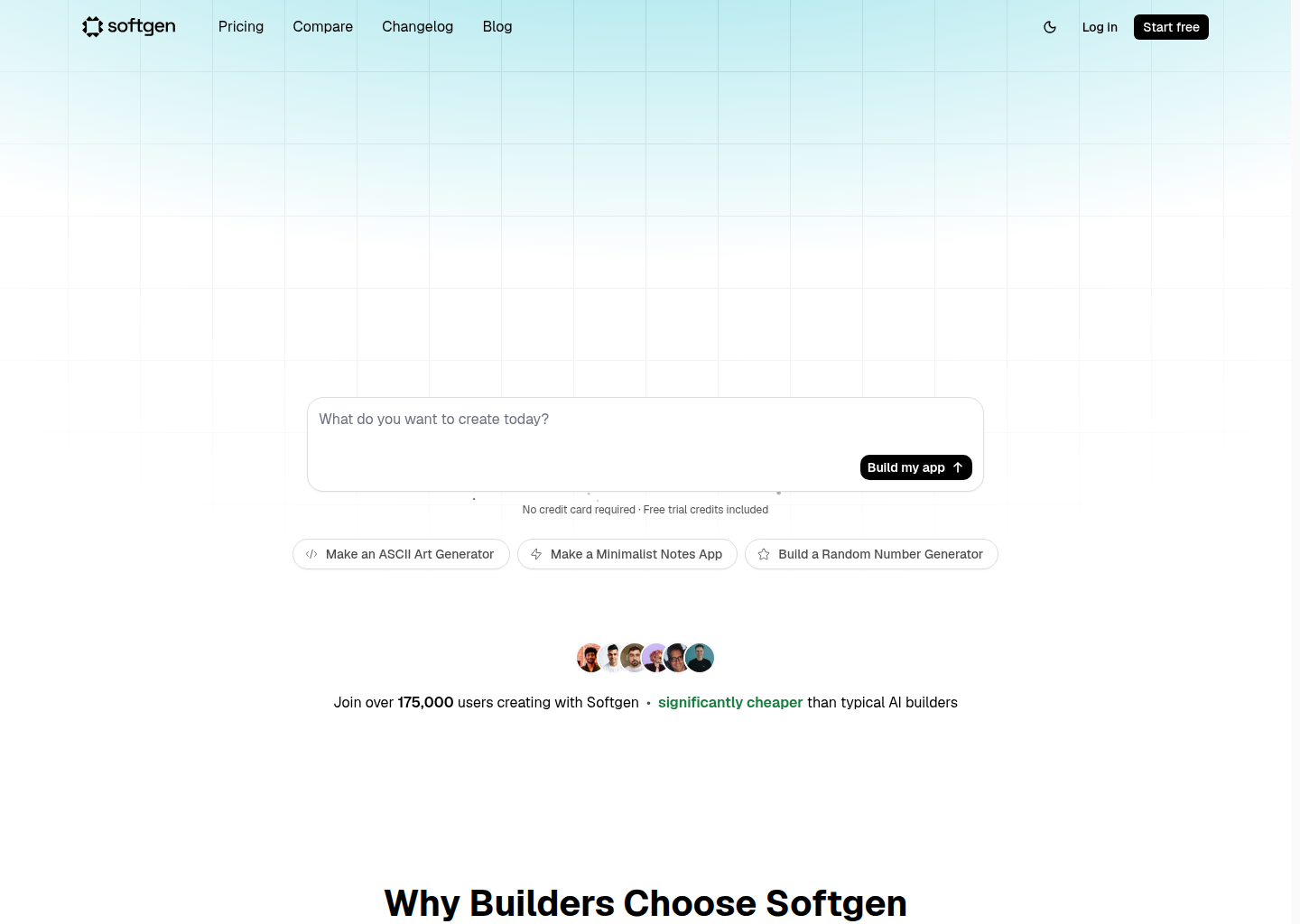
Softgen is an AI web app builder from Softgen Labs that turns natural language into full-stack web applications with deployment and version-history tooling. As a Windsurf alternative, it is best suited for builders who want production-oriented web app generation instead of an editor-centered coding assistant. Softgen focuses on shipping web products with backends, model choice, and deployment paths instead of trying to feel like a conventional code editor.
Softgen vs. Windsurf: Quick Comparison
| Softgen | Windsurf | |
|---|---|---|
| Type | AI web app builder | AI IDE |
| IDEs | Browser-based builder with GitHub version history and deployment workflow | Standalone editor with built-in agent workflow |
| Pricing | $33/year membership plus pay-as-you-go AI usage | Not publicly documented |
| Models | Claude 4.5, GPT-5.5, Gemini 3.1 Pro, and 10+ supported models | Not publicly documented |
| Privacy / hosting | Cloud builder with support for external backends such as Supabase and Firebase; deeper hosting details are not publicly documented | Cloud-first workflow |
| Open source | No | No |
Key Strengths
- Production-oriented app scope: Softgen is not limited to mockups or throwaway frontends. Its public positioning is about full-stack web apps, which makes it more relevant when you need auth, data, and shipping workflows rather than just code suggestions.
- Flexible model strategy: Softgen publicly markets multi-model support instead of locking users to a single provider. That matters for teams balancing quality, speed, and cost across different kinds of generation work.
- Clearer economic model than many app builders: The official pricing page emphasizes a $33 yearly membership and pay-as-you-go AI usage instead of large monthly bundles. For cost-conscious builders, that is easier to reason about than expiring credits hidden inside bigger subscriptions.
Known Limitations
- Not an IDE-native workflow: Softgen is built as a browser-based app builder, not an always-open editor companion. Developers who want live pair programming inside an IDE may find Windsurf more natural for daily coding.
- Web-app emphasis narrows the fit: Softgen is strongest for shipping web products and internal tools. If your workflow is mostly repository maintenance, local terminal work, or codebase navigation, Windsurf remains the tighter match.
Best For
Softgen is best for founders, indie hackers, and small product teams that want to turn requirements into a working web app quickly. It is especially compelling when you care more about getting a full-stack product scaffold than about living inside a traditional IDE.
It also makes sense for technical builders who want model choice and a more explicit cost structure. Instead of paying for a monolithic editor subscription, you can keep a low fixed fee and spend on generation as needed.
Pricing
- Membership: Softgen publicly advertises an annual platform license at $33 per year.
- Usage: AI usage is pay-as-you-go rather than bundled into a fixed monthly subscription. The pricing page explicitly says there are no monthly fees.
Prices are subject to change. Check the official pricing page for current details.
Tech Details
- Type: AI web app builder
- IDEs: Browser-based builder with GitHub version history and deployment workflow
- Key features: full-stack builder, GitHub version history, team collaboration, preview and deployment workflow, Supabase support, Firebase support
- Privacy / hosting: Cloud builder with support for external backends such as Supabase and Firebase; deeper hosting details are not publicly documented
- Models / context window: Claude 4.5, GPT-5.5, Gemini 3.1 Pro, and 10+ supported models
Setup and Workflow
Softgen starts from a product brief, then generates a full-stack web app rather than just file-level edits. That shifts the comparison with Windsurf away from editor ergonomics and toward shipping speed for greenfield work.
The public materials also highlight GitHub version history, team collaboration, and preview plus deployment capabilities. Those cues suggest Softgen is trying to be a lightweight product factory, not just a code assistant wrapper.
Because it supports multiple major model families, Softgen is also useful for teams that want to route different tasks to different models. Windsurf users can sometimes approximate that with their own model choices, but Softgen makes it part of the product story.
Typical Use Cases
- MVP generation: Softgen is a strong option when you need a working web product foundation fast. The platform is explicit about full-stack app generation instead of stopping at isolated UI components.
- Internal tools and dashboards: If you need forms, data views, and backend-connected flows, Softgen's scope is closer to what teams actually deploy. That makes it more practical than an IDE-native agent when the goal is end-to-end scaffolding.
- Cost-aware experimentation: The pricing model is useful for builders who want to keep fixed costs low while testing a lot of ideas. Paying a low annual fee plus metered AI usage can be friendlier than committing to another full subscription stack.
Team and Operational Fit
Softgen fits teams that care about shipping, iteration, and code ownership more than about replacing VS Code or JetBrains. Its operational center of gravity is the generated application, not the editing surface.
This matters for collaboration too. Public materials mention team collaboration, GitHub version history, and deployment flow, which is exactly the sort of workflow a small software team needs once a project moves beyond demo stage.
The main trade-off is that you give up some of the immediacy of an AI IDE. Windsurf can be more efficient when the task is incremental repository work instead of creating or extending a web product from the top down.
When to Choose This Over Windsurf
- Choose Softgen when you want an AI system to generate and iterate on an entire web app rather than behave like a coding copilot inside an editor.
- Choose Softgen when multi-model flexibility and a low fixed annual fee matter more than an IDE-native UX.
- Choose Softgen when your work starts from product requirements, data flows, and deployment needs instead of from an existing editor session.
When Windsurf May Be a Better Fit
- Windsurf may be better if your main job is editing an existing repository all day and you want the agent embedded directly in your coding surface.
- Windsurf may be better if local terminal loops, navigation, and in-editor interventions matter more than app-level scaffolding.
- Windsurf may be better if you need a coding assistant for broad software engineering tasks beyond web-app generation.
Conclusion
Softgen is a credible Windsurf alternative for builders who care about generating and shipping full-stack web apps quickly. Its strongest differentiators are multi-model flexibility, explicit app-builder scope, and a lean annual-plus-usage pricing model.
If your workflow is product-first rather than editor-first, Softgen deserves a place in the same shortlist as Windsurf. If you mainly want an AI IDE for day-to-day repository work, Windsurf still has the cleaner fit.
Sources
FAQ
Is Softgen free?
Softgen is not fully free, but its public pricing is lighter than many competitors. The platform advertises a $33 yearly membership and pay-as-you-go AI usage rather than a standard monthly subscription.
Does Softgen work with VS Code?
The official materials used here position Softgen as a browser-based builder with GitHub version history and deployment flow. They do not position it as a VS Code-native IDE assistant.
How does Softgen compare to Windsurf?
Softgen is stronger for app-level generation and shipping workflows, while Windsurf is stronger for editor-native coding. The right choice depends on whether you are building a product scaffold or doing day-to-day IDE work.
What backends does Softgen support?
Softgen publicly documents support around modern web-app workflows and references both Supabase and Firebase in its learning materials. That gives it a more product-oriented full-stack story than many pure code assistants.
What models does Softgen support?
Softgen publicly advertises support for Claude 4.5, GPT-5.5, Gemini 3.1 Pro, and more than ten models overall. That is one of its clearest differentiators versus tools that hide model choice.
Additional Notes
Softgen's most important difference from Windsurf is that it thinks in terms of app outcomes instead of developer presence. The product pitch is about building, previewing, and deploying a web application, not about keeping you inside a smarter editor all day.
That makes it especially useful for founders and operators who can describe the product they need but do not want to stitch together backend, auth, and deployment manually. Even technical users can benefit when the task is more greenfield than maintenance-oriented.
The multi-model story also matters. When a platform explicitly supports multiple leading models, you can optimize for price or quality on a task-by-task basis instead of inheriting whatever a single-vendor product decides to expose.
The downside is that if you already have a mature repository and want a fast-moving AI coding environment, Windsurf still feels closer to the center of day-to-day engineering. Softgen is better understood as a build-and-ship platform than as an IDE substitute.
Additional Evaluation Notes
Softgen becomes more interesting as soon as the project needs real product surface area. A lot of AI coding tools are strong at snippets or quick fixes, but weaker at turning a prompt into a coherent full-stack application. Softgen's public positioning is much closer to app assembly, which is why it competes with Windsurf from a different layer of the stack.
It is also easier to justify for fast product experiments because the cost model is legible. A low annual platform fee plus metered model usage can be simpler for a small team than stacking several monthly subscriptions before the product idea is even validated. That predictability is one reason founders keep comparing it with other vibe-coding builders.