Tempo
Contact
Tempo
Collaborative AI app builder for turning prompts into React-style interfaces, product surfaces, and frontend workflows faster.
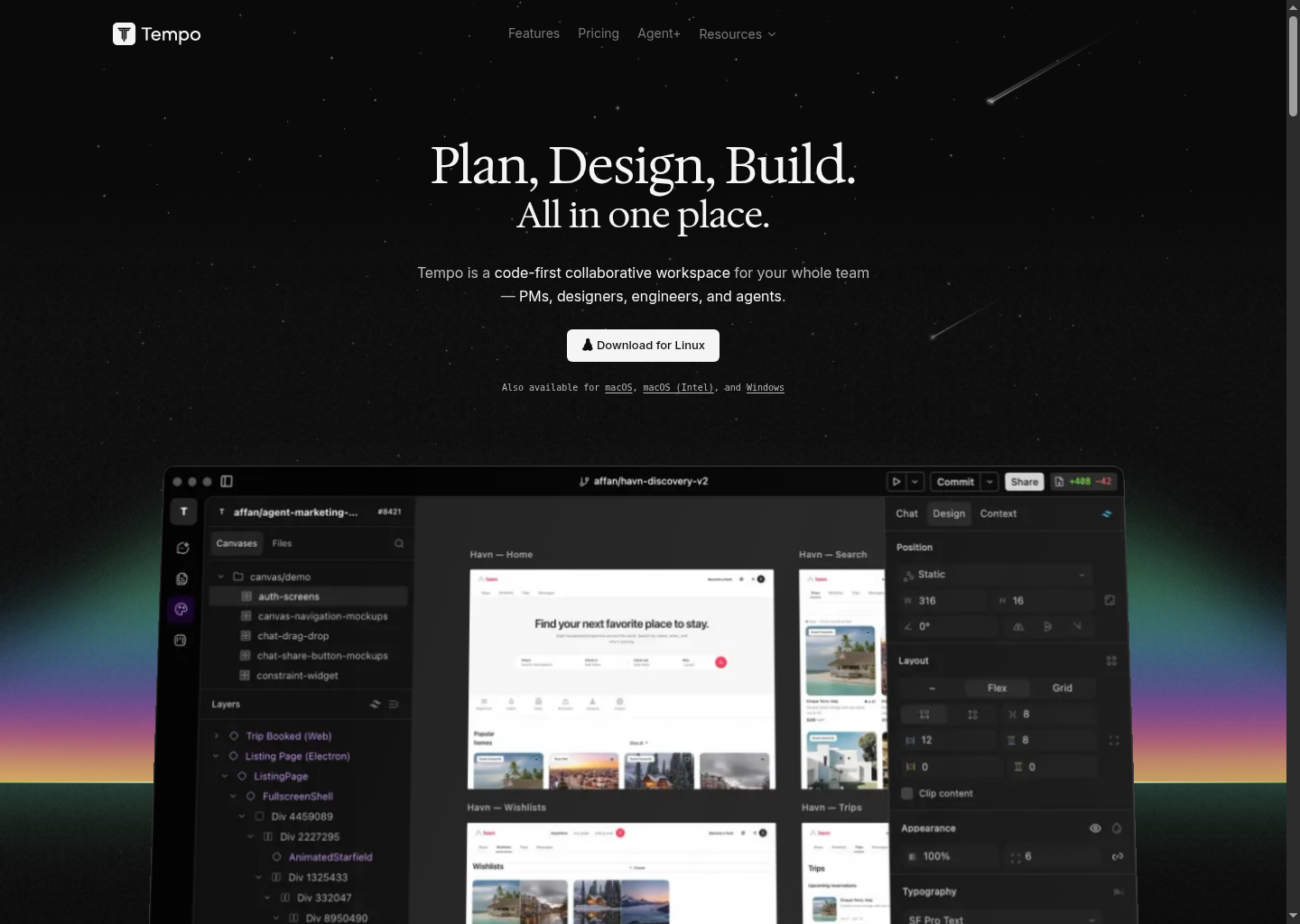
Tempo: A Windsurf Alternative for prompt-driven web app building with design and collaboration in one workflow
Tempo is a AI app builder developed by Tempo Labs. It blends prompting, development, design, and collaboration for React-style product building instead of focusing on an IDE-only coding experience. As a Windsurf alternative, it is best suited for product teams and solo builders that want to move from prompt to UI and app collaboration quickly.
The official messaging for Tempo centers on prompting, development, design, and collaboration. That language matters because it defines the product as a collaborative app-building environment first and a coding surface second.
Tempo vs. Windsurf: Quick Comparison
| Tempo | Windsurf | |
|---|---|---|
| Type | AI app builder | AI IDE |
| IDEs | Browser | Standalone / editor-centric workflow |
| Pricing | Discover AI-powered tools at Tempo to prompt, develop, and design code effortlessly. Collaborate seamlessly with advanced solutions for faster, smarter web development. | Not publicly documented on Windsurf pricing in this run. |
| Models | Not publicly documented on the reviewed homepage | Not publicly documented in this run |
| Privacy / hosting | Cloud-hosted collaborative product | Not publicly documented in this run |
| Open source | No | No |
Key Strengths
- Design-plus-build workflow: Tempo explicitly combines prompting, development, design, and collaboration. That makes it attractive for product teams that want a broader app-building surface than Windsurf's IDE focus.
- Browser-first collaboration: Tempo is optimized for web-based collaboration around app creation. That is useful when product, design, and engineering need to work closer together in one tool.
- Strong UI generation positioning: Community feedback repeatedly highlights speed for building interfaces and React-style experiences. It can be a better fit than Windsurf when frontend output and iteration speed matter most.
Known Limitations
- Less traditional IDE depth: Tempo is not positioned as a conventional local IDE replacement. Developers who want terminal-heavy workflows or lower-level editor control may find Windsurf stronger.
- Mixed stability feedback: Community reviews mention auth issues, AI correction loops, and support rough edges. That raises execution risk for complex production work.
Best For
Tempo is aimed at teams that care about turning prompts into working interfaces and app iterations fast. Its positioning is broader than a plain AI code editor because design collaboration is part of the workflow. Compared with Windsurf, it is stronger for people who want app building and design collaboration in one browser-first product.
The product is therefore attractive in teams where product, design, and engineering sit close together. Instead of staying inside an IDE, users can move through prompts, generated UI, collaboration, and iteration in a shared surface. That is a broader workflow than Windsurf's editor-native focus.
Pricing
- Pricing page: Tempo maintains a dedicated pricing page, but exact plan text was not fully captured in this run's lightweight official crawl.
- Commercial positioning: The product is clearly sold as a paid collaborative app-building platform rather than a free open-source utility.
Prices are subject to change. Check the official pricing page for current details.
Tech Details
- Type: AI app builder
- IDEs: Browser
- Key features: prompt-driven app building, UI generation, collaboration, design workflow, browser-first development
- Privacy / hosting: Cloud-hosted collaborative product
- Models / context window: Not publicly documented on the reviewed homepage
Common Use Cases
- Generating and iterating on React-style interfaces quickly when product, design, and engineering need to collaborate in the same loop.
- Building internal tools, dashboards, and web experiences where frontend speed and collaborative review matter more than terminal-centric coding.
- Using prompts to create a first product surface that designers and developers can refine together before deeper engineering hardening starts.
These are important because Tempo is not simply trying to replace a code editor. It is trying to compress the space between design intent and working frontend output. In buying terms, that means it competes with Windsurf whenever a team values collaborative UI creation more than it values a traditional IDE feel.
Workflow Fit
Tempo is most useful when the frontend surface is the product. Teams building dashboards, internal tools, and product interfaces can move from prompt to UI and collaborate around the result without forcing everyone into a local coding environment. That makes it more app-builder-like than Windsurf, even though both live in the AI software creation category.
A Windsurf user moving to Tempo will gain more design-first collaboration but lose some of the familiar IDE expectations. Tempo is not trying to win by being the deepest coding editor. It is trying to speed up the path from concept to collaborative product surface.
Operational Notes
Operationally, Tempo introduces a browser-first collaboration surface instead of a conventional local coding environment. That can speed up the frontend side of product creation because more stakeholders can see and influence the output earlier. The tradeoff is that deeper engineering workflows may still need another layer once the project becomes more complex.
Tempo is strongest in teams where design and product decisions happen continuously during implementation. Frontend-heavy groups, agencies, and startup product teams are likely to see the biggest upside. Backend-heavy teams or terminal-native developers may not get enough value from the collaboration layer to justify replacing an IDE-like workflow.
Community Feedback Snapshot
Community feedback for Tempo shows a clear split. Users often praise the speed of building React-style interfaces, the real-time collaboration feel, and the design-to-code loop. At the same time, Product Hunt and Reddit discussions also mention auth issues, AI correction loops, freezes, and cases where the tool appears to act without producing the expected code changes.
That makes Tempo compelling for fast frontend experimentation, but less trustworthy as a universal engineering environment. It is a credible Windsurf alternative when UI velocity and collaboration matter most, but it carries execution-risk caveats that serious teams should test early.
How to Evaluate It Against Windsurf
The cleanest way to compare Tempo with Windsurf is to ask whether your bottleneck is code production or collaborative product shaping. Windsurf is stronger when code ergonomics and developer execution are central. Tempo is stronger when the workflow must also include visual iteration and shared frontend decision-making.
Because community feedback is mixed on stability, teams should test a realistic multi-step project rather than a single happy-path demo. If the collaboration and speed benefits hold up under real usage, Tempo can be a strong Windsurf alternative for frontend-centric work. If not, Windsurf's more coding-oriented workflow may remain the safer default.
Where It Fits in a Modern AI Dev Stack
Tempo fits into the modern AI stack as a collaborative frontend acceleration layer. It can sit between design systems, product iteration, and generated application code, which is different from tools that focus primarily on code editing or autonomous terminal work. That position makes it especially relevant in teams where the product surface changes often and visual feedback loops are part of engineering work.
Selection should center on whether collaboration and UI throughput are more valuable than classic IDE depth. If the answer is yes, Tempo deserves strong consideration because its workflow is built around prompts, visual iteration, and shared product output. If the answer is no, Windsurf will usually remain the better fit because it stays closer to a developer-native coding environment.
Adoption Path
Tempo is best adopted through a frontend-heavy pilot where the value of collaboration and rapid interface iteration can be measured directly. Teams should use a real dashboard, internal tool, or customer-facing UI concept and see whether Tempo reduces the feedback loop between design intent and working output. That is where its value proposition is easiest to prove honestly.
Rollout should also test stability under multi-step usage, not just first impressions. If the collaboration flow stays productive after several iterations, Tempo can justify itself as a Windsurf alternative for frontend-led work. If the workflow starts breaking under complexity, Windsurf may remain the safer long-term environment for engineering execution. This matters most in product teams where designers, PMs, and frontend engineers all need to touch the same evolving surface and where delays in UI iteration have real delivery cost. It is especially relevant for teams shipping React-heavy products, internal dashboards, and customer-facing frontend experiments every week.
When to Choose This Over Windsurf
- You want prompt-to-UI and collaboration in one browser-first product flow.
- Your workflow includes design and frontend iteration, not just code editing.
- You need a faster path from idea to React-style app surface than a pure IDE workflow gives you.
When Windsurf May Be a Better Fit
- Windsurf is better for developers who want an AI IDE centered on coding rather than a collaborative app-building workspace.
- Windsurf will usually fit backend-heavy or terminal-heavy workflows better than Tempo.
- Teams that prioritize repository-native coding ergonomics over design collaboration may prefer Windsurf.
Conclusion
Tempo is a solid Windsurf alternative for teams that want prompting, app building, UI generation, and collaboration wrapped into one browser workflow. It is less about replacing a local IDE directly and more about speeding up product creation around the frontend layer.
Sources
FAQ
Is Tempo free?
Tempo is positioned as a commercial product. A dedicated pricing page exists, but exact plan details were not fully captured in this run.
Does Tempo work with VS Code?
The official homepage reviewed in this run presents Tempo as a browser-first collaborative tool, not as a VS Code extension.
How does Tempo compare to Windsurf?
Tempo is more collaborative and UI-oriented, while Windsurf is more IDE- and coding-workflow-oriented.
Who should choose Tempo?
Product-minded builders who want prompt-driven app creation and fast frontend collaboration in one place.