Vitara AI
Contact
Vitara AI
Prompt-first AI app builder for product teams that want chat-based full-stack app generation with downloadable code and custom domains.
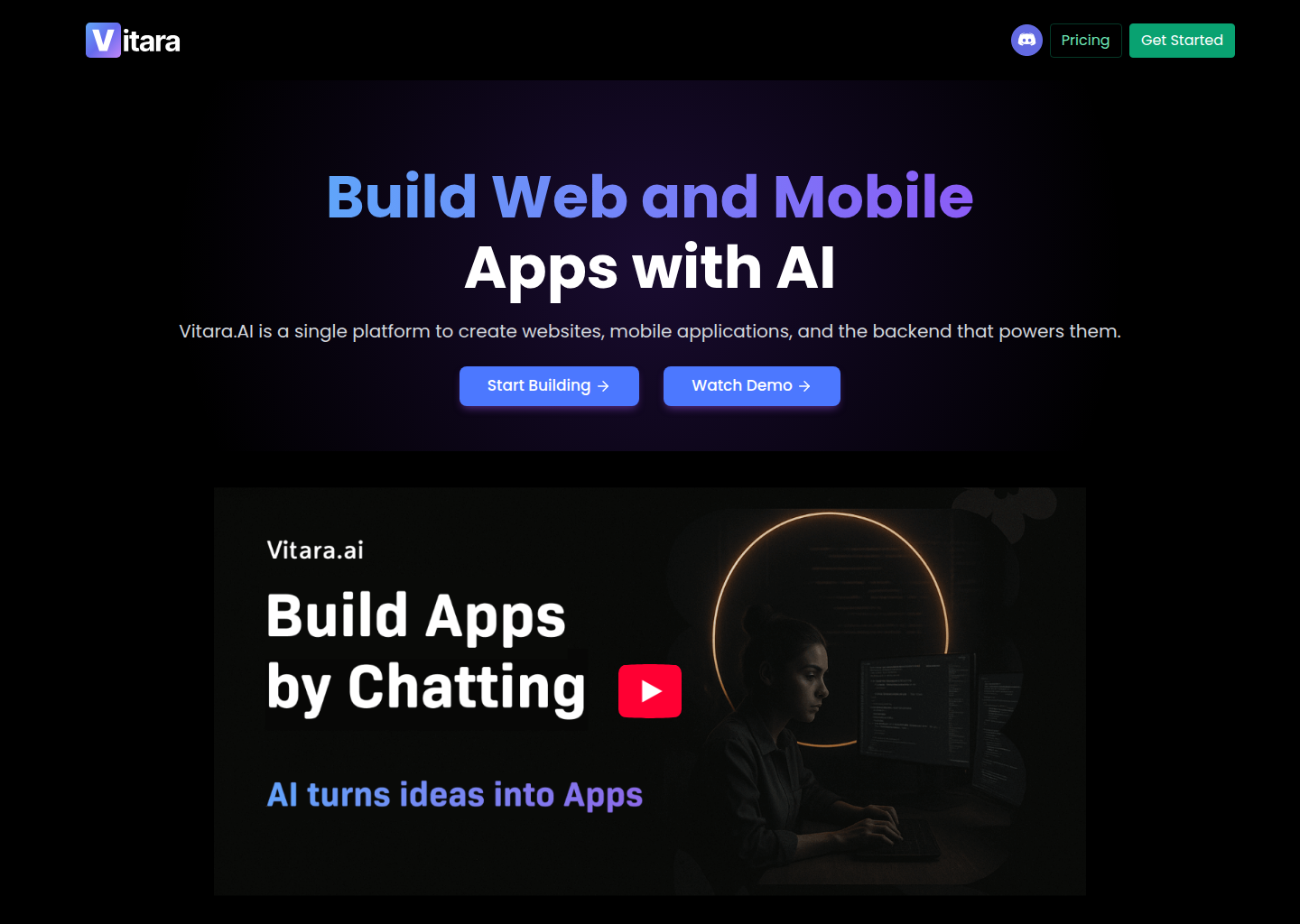
Vitara AI: A Windsurf alternative for product teams and founders who want a chat-led full-stack app builder with downloadable code and custom-domain support
Vitara AI is a AI app builder developed by Vitara AI. It is best understood as a browser-led product builder rather than an editor-native coding environment. As a Windsurf alternative, it fits product teams and founders who want a chat-led full-stack app builder with downloadable code and custom-domain support.
Vitara AI vs. Windsurf: Quick Comparison
| Vitara AI | Windsurf | |
|---|---|---|
| Type | Ai App Builder | AI IDE |
| IDEs | Browser-based chat builder with web previews and hosted deployment workflow | Standalone / editor-centric workflow |
| Pricing | Free plan with limited usage and no credit card required. | Not publicly documented in this listing |
| Models | Not publicly documented | Not publicly documented in this listing |
| Privacy / hosting | Cloud-hosted builder with downloadable code and paid custom-domain support | Not publicly documented in this listing |
| Open source | No | Not publicly documented in this listing |
Key Strengths
- Clear product-builder positioning: Vitara AI explains itself in a way that is easy for product-oriented buyers to understand. It is selling a chat-led path from prompt to app, not a dense technical environment that assumes IDE habits first. That clarity helps when a founder or product manager needs to evaluate the platform quickly.
- Good balance between simplicity and ownership: Vitara is not only a disposable prototype surface. The public pricing story includes downloadable code and custom-domain support, which gives the product a more believable long-term path than platforms that never explain how you leave. That makes it more credible as a serious early-stage build environment.
- Accessible entry point for evaluation: A free plan with no credit card requirement lowers the barrier to honest testing. Teams can check whether the generation loop, previews, and product feel are useful before they commit to a paid workflow. That matters because the category is crowded and many tools look similar until you actually use them.
- Strong fit for cross-functional product work: Vitara can be easier than an AI IDE when the people shaping the product are not all engineers. A browser-based, chat-driven app-builder surface is easier for product-minded collaborators to follow, which can shorten the path from idea to visible result.
Known Limitations
- Less transparent technical depth: Vitara's public messaging is stronger on what the product helps you build than on how its deeper technical machinery works. Model support, context-window detail, and lower-level infrastructure behavior are not documented richly in the reviewed material. Technical buyers will likely want a second validation step before betting heavily on it.
- Not designed for repository-first maintenance: Vitara is strongest when the work begins as product creation through chat. It is weaker when the main need is living inside a codebase, tracing bugs, or making disciplined multi-file edits over time. That is where Windsurf's AI IDE shape feels more aligned with reality.
- Managed pricing still changes behavior: Like other hosted builders, Vitara turns iteration into a plan-and-credits conversation. That is acceptable for many early product teams, but it is still a different operating model from an IDE assistant that stays closer to code ownership and engineering routine. Buyers should decide whether that trade is leverage or friction for their stage.
Best For
Vitara AI is best for founders, startups, and product teams that want to compress ideation, generation, previewing, and deployment into a browser workflow. It works well when speed-to-first-product matters more than deep IDE ergonomics.
It is less convincing for engineering-heavy teams that already know the repository is the center of work. In that case, Windsurf usually offers a more natural environment because the AI stays inside the codebase instead of surrounding it with a hosted product platform.
Pricing
- Free: Free plan with limited usage and no credit card required.
- Build: $20/month.
- Scale: $50/month for larger monthly usage.
Prices are subject to change. Check the official pricing page for current details.
Tech Details
- Type: Ai App Builder
- IDEs: Browser-based chat builder with web previews and hosted deployment workflow
- Key features: chat-based app generation, browser previews, downloadable code on paid plans, custom domains, hosted workflow, product iteration through chat
- Privacy / hosting: Cloud-hosted builder with downloadable code and paid custom-domain support
- Models / context window: Not publicly documented
Workflow Fit
Vitara AI moves the center of activity into a browser chat workflow where app generation, previews, and deployment all sit close together. That is valuable when the friction of starting is more painful than the complexity of maintaining a project later.
Once the project grows, the evaluation changes. Teams then have to decide how much of the workflow should remain inside the platform versus shift toward a more normal repository-owned process. That is exactly where a tool like Windsurf often becomes the stronger long-term companion.
When to Choose This Over Windsurf
- Choose Vitara AI when the primary goal is quickly shipping a new product surface through chat, previews, and managed hosting.
- Choose Vitara AI when downloadable code and custom-domain support are enough ownership for the current stage and browser collaboration matters more than IDE fidelity.
- Choose Vitara AI when non-terminal users need to help shape the build directly inside the product workflow.
When Windsurf May Be a Better Fit
- Windsurf is a better fit when the team already works inside a codebase and wants AI help without leaving that environment.
- Windsurf is a better fit when terminal habits, tests, scripts, and long-lived engineering routines matter more than prompt-led app generation.
- Windsurf is a better fit when buyers need a classic AI IDE rather than a hosted builder with plan-based usage.
Evaluation Questions Before You Choose
Ask whether your team needs a builder or an IDE first. Vitara is stronger when the team needs a builder. Windsurf is stronger when the team needs an IDE that happens to have AI capabilities.
Ask whether exportability and custom domains are enough for the current phase or whether full repository-native control is already a requirement. That answer usually separates the right buyer for Vitara from the right buyer for Windsurf.
Implementation and Adoption Notes
The biggest implementation question is not whether Vitara AI can generate an impressive first result. It is whether the team is comfortable letting a hosted AI app builder shape the early product workflow before the project settles into a more conventional repository rhythm. For teams that already accept browser-led generation as a valid first phase, that trade can be productive rather than risky.
Adoption usually works best when the operators are product-minded builders, founders, or engineers who care about shipping a visible product quickly and do not need every decision to start inside an IDE. In that environment, Vitara AI can reduce setup friction and make collaboration easier because the work is understandable outside a terminal window. Teams that expect every contributor to think in branches, scripts, and tests from the first day may find the transition less natural.
Cost and Governance
Like most tools in this category, Vitara AI changes the spending conversation from raw development hours to plan design, credits, and platform boundaries. That is not automatically bad. It can be a worthwhile trade when the hosted workflow removes enough setup work, stakeholder back-and-forth, and prototype churn to offset the subscription cost. It becomes harder to justify when the team mainly wants an AI assistant for code it already owns.
Governance questions also deserve a direct answer before standardization. Buyers should validate what happens after the first successful build, how much of the generated project can move into a normal repository workflow, and whether the current ownership path matches internal expectations. Vitara AI is more attractive when those answers are clear and less attractive when the team needs deeper technical transparency than the public material currently provides.
Migration Considerations
Switching from Windsurf to Vitara AI is not just a feature swap. It is a workflow shift from an AI IDE toward a managed AI app builder that treats product creation, previewing, and deployment as part of one hosted experience. Teams should make that move only if the early product-building speed genuinely matters more than staying inside an editor-shaped environment.
A practical compromise for many teams is to use Vitara AI when the project is still taking shape, then move the resulting code and longer-term maintenance back into an IDE-centered workflow. That pattern works best for teams that see builders and IDEs as different tools for different phases rather than as mutually exclusive bets. If that handoff path already sounds awkward, Windsurf may be the better fit from the start.
Conclusion
Vitara AI is a practical Windsurf alternative for teams that want a guided, chat-led app-building surface instead of starting from an AI IDE. Its strongest argument is speed and accessibility around new-product creation, not deep repository-native engineering.
Pick Vitara AI when browser-based product generation is the main job and downloadable code is enough ownership for now. Stay with Windsurf when the team already knows the codebase is the operational center and wants the AI to stay there too.
Sources
FAQ
Does Vitara AI have a free plan?
Yes. The public pricing page says there is a free plan with no credit card required.
Can you download code from Vitara AI?
Yes. Downloadable code is referenced in the paid-plan story.
How is Vitara AI different from Windsurf?
Vitara AI is a hosted chat-based app builder, while Windsurf is an AI IDE for working inside code.
Who should skip Vitara AI?
Teams that mostly need repository-native coding, debugging, and engineering control should prefer Windsurf.