Google Antigravity
Contact
Google Antigravity
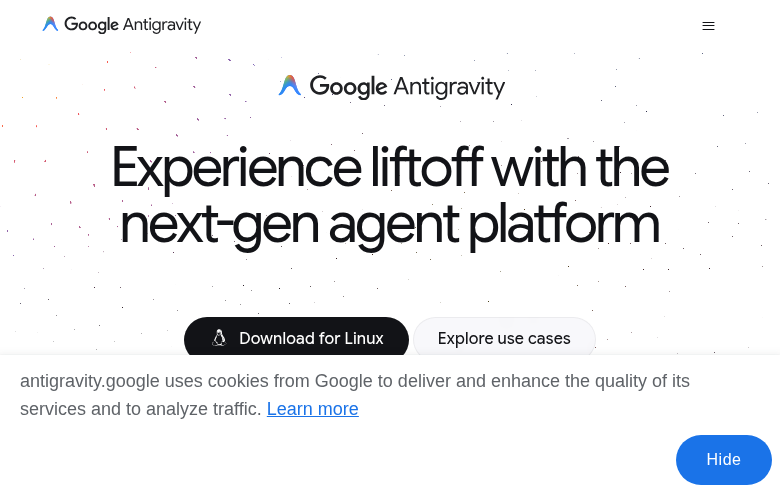
Google Antigravity: A Windsurf Alternative for Agent-First AI Development
Google Antigravity is an agent-first AI IDE developed by Google, released in public preview in November 2025. Built as a VS Code fork powered primarily by Gemini 3.1 Pro with a 2-million-token context window, it introduces a dual-view paradigm: an Editor view for traditional coding and a Manager view for orchestrating multiple autonomous agents in parallel. As a Windsurf alternative, it is best suited for developers who want a free, cutting-edge AI IDE with massive context and Google-native multi-agent orchestration.
Google Antigravity vs. Windsurf: Quick Comparison
| Google Antigravity | Windsurf | |
|---|---|---|
| Type | AI IDE (VS Code fork) | AI IDE (standalone) |
| IDEs | Standalone AI IDE — macOS, Windows, Linux | Standalone / editor-centric workflow |
| Pricing | Free during public preview; paid tiers not yet announced | Free tier + Pro $20/month (as of March 2026) |
| Models | Gemini 3.1 Pro (2M context), Gemini 3 Flash, Claude Sonnet 4.6, Claude Opus 4.6, GPT-OSS-120B | Cascade + SWE-1.5 (proprietary) |
| Privacy / hosting | Cloud (Google infrastructure) | Cloud (Windsurf/Cognition) |
| Open source | No (proprietary, free preview) | No |
Key Strengths
- Gemini 3.1 Pro with 2-Million-Token Context Window: Google Antigravity's primary model, Gemini 3.1 Pro, supports a 2-million-token context window — one of the largest available in any AI coding tool as of early 2026. This means developers can include entire large codebases, extensive documentation, and long conversation histories in a single context, reducing the need to manually manage what the model knows at any given time.
- Multi-Agent Manager View: Unlike Windsurf's single-agent flow, Google Antigravity introduces a Manager view that allows multiple autonomous agents to work in parallel across different tasks within the same workspace. Developers can spawn multiple agents simultaneously — one writing tests while another refactors code — and oversee all of them from a single central mission control interface.
- Multi-Model Flexibility: Google Antigravity supports Gemini 3.1 Pro, Gemini 3 Flash, Claude Sonnet 4.6, Claude Opus 4.6, and GPT-OSS-120B within a single IDE. This model diversity lets developers choose the right model for the task — using Gemini 3 Flash for speed on smaller edits, or Gemini 3.1 Pro and Claude Opus 4.6 for complex reasoning tasks — without leaving the IDE.
- Free During Public Preview: As of May 2026, Google Antigravity is entirely free during its public preview with generous rate limits on Gemini 3.1 Pro. No paid subscription is required to access the full multi-agent and context window capabilities, making it one of the most capable free AI IDEs available today.
Known Limitations
- Still in Public Preview: Google Antigravity was released in November 2025 and is still in public preview as of May 2026. The feature set, pricing, and stability may change rapidly as Google iterates toward a general availability release. Teams that need production-grade stability may prefer a more established tool.
- No JetBrains Support: As a VS Code fork, Google Antigravity only supports its own standalone IDE environment and does not offer extensions for JetBrains IDEs such as IntelliJ IDEA or PyCharm. Developers who prefer JetBrains tooling will need to use a different tool or wait for potential future extension support.
- Smaller Community and Ecosystem: Compared to Windsurf and Cursor, Google Antigravity has a smaller community, fewer tutorials, and less third-party integration at this stage. Extension and plugin ecosystems are also more limited given the tool's recent launch.
Best For
Google Antigravity is ideal for developers who want to experiment with the frontier of AI-assisted development without paying a subscription. It is particularly compelling for teams building large codebases that benefit from the 2-million-token context window, or for developers who want to orchestrate multiple autonomous agents simultaneously on complex projects. Engineers already comfortable with the VS Code ecosystem and interested in Google's AI capabilities will find Google Antigravity a natural fit.
Pricing
- Free (Public Preview): Available at no charge with generous rate limits on Gemini 3.1 Pro. No paid tiers have been announced as of May 2026.
- Coming Soon — Organization Tier: An organizational/team tier has been announced as "coming soon" but pricing has not been disclosed.
Prices are subject to change. Check the official pricing page for current details.
Tech Details
- Type: AI IDE (VS Code fork)
- IDEs: Standalone AI IDE — available on macOS, Windows, and Linux
- Key features: Agent-first paradigm with Editor view + Manager view (parallel agents), 2-million-token context window (Gemini 3.1 Pro), autonomous agents with Artifacts (task lists, screenshots, browser recordings), direct terminal and browser access, multi-agent orchestration, multi-model support
- Privacy / hosting: Cloud (Google infrastructure)
- Models / context window: Gemini 3.1 Pro (2M token context), Gemini 3 Flash, Claude Sonnet 4.6, Claude Opus 4.6, GPT-OSS-120B
When to Choose Google Antigravity Over Windsurf
- You want a free AI IDE with access to Gemini 3.1 Pro and a 2-million-token context window without a paid subscription.
- You need to run multiple autonomous agents simultaneously on different parts of a large codebase from a single Manager view.
- You want model flexibility — switching between Gemini, Claude, and GPT-class models within a single IDE based on task complexity.
- You are comfortable with a VS Code-based workflow and want to try cutting-edge Google AI capabilities embedded natively in an IDE.
- You are working on projects with very large codebases or documentation sets that benefit from a 2M-token context window.
When Windsurf May Be a Better Fit
- You need a production-stable AI IDE backed by a track record of consistent updates and a larger user community.
- You prefer the Cascade/SWE-1.5 model experience optimized specifically for software engineering tasks with battle-tested performance.
- You require JetBrains support or specific integrations that Windsurf has and Google Antigravity does not yet offer.
- You want a tool with established paid pricing and SLAs rather than one still in public preview with potential changes ahead.
Conclusion
Google Antigravity is the most compelling free Windsurf alternative for developers who want frontier AI capabilities — especially the 2-million-token context window, multi-agent Manager view, and access to Gemini 3.1 Pro, Claude, and GPT-class models in one IDE. For teams that need stability or JetBrains support, Windsurf remains the safer choice while Google Antigravity matures toward general availability.
Sources
FAQ
Is Google Antigravity free?
Yes, Google Antigravity is currently free during its public preview, including access to Gemini 3.1 Pro with a 2-million-token context window and generous rate limits. No paid tier has been announced as of May 2026. An organizational tier has been teased as "coming soon" with pricing to be disclosed at a later date.
Does Google Antigravity work with VS Code?
Google Antigravity is itself a VS Code fork — a standalone IDE that inherits the VS Code interface and extension ecosystem. It does not run as a plugin inside an existing VS Code installation; it is a separate application. It currently does not support JetBrains IDEs such as IntelliJ IDEA or PyCharm.
How does Google Antigravity compare to Windsurf?
Both are standalone AI IDEs built on VS Code. Google Antigravity's key differentiators are its 2-million-token context window with Gemini 3.1 Pro, multi-agent Manager view for parallel agent orchestration, and multi-model support (Gemini, Claude, GPT). Windsurf's differentiators include a more established user community, its proprietary Cascade/SWE-1.5 models, and greater production stability. Google Antigravity is currently free during preview; Windsurf charges $20/month for Pro.
What models does Google Antigravity support?
As of May 2026, Google Antigravity supports Gemini 3.1 Pro (primary model with 2M-token context), Gemini 3 Flash, Claude Sonnet 4.6, Claude Opus 4.6, and GPT-OSS-120B. This multi-model approach lets developers choose the right model for each task within a single IDE without switching tools.