
Trae
Trae
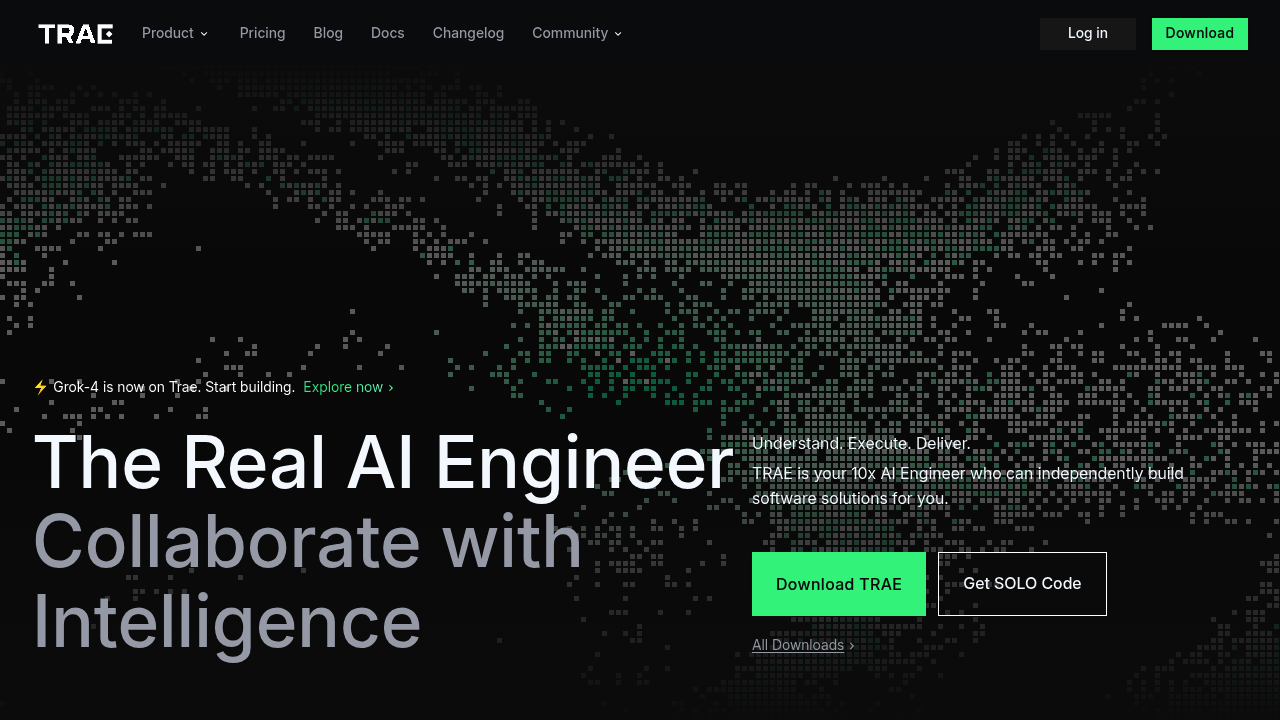
Trae is an AI-integrated code editor developed by ByteDance that is built on VS Code. The platform provides intelligent code completion, conversational programming through chat interfaces, and Builder Mode that automatically breaks down complex projects into manageable tasks. Solo developers might prefer it for free access to premium AI models like Claude 3.5 Sonnet and GPT-4o without subscription costs, though telemetry concerns have been raised regarding persistent data collection even when users disable tracking settings.
Strengths
- Completely free access to advanced AI models including Claude 3.5 Sonnet, Claude 3.7, and GPT-4o during early access period.
- Builder Mode automatically plans multi-file code changes with live preview before applying edits, following a methodical planning-first approach.
- Built on VS Code foundation, supporting most VS Code extensions with seamless settings migration from VS Code and Cursor.
- Integrated webview feature allows previewing and interacting with web applications directly within the editor without switching windows.
- Max Mode supports up to 200 rounds of automatic tool calls with context windows reaching 200k tokens for Kimi and 272k for GPT-5.
- Model Context Protocol (MCP) support enables connecting external tools and services into the IDE agent workflow.
Weaknesses
- Security research identified sophisticated telemetry framework with persistent connections to ByteDance servers that continues transmitting data even when telemetry is disabled in settings.
- Testing revealed Trae consumed 6.3 times more RAM than VS Code and three times more memory than Cursor, though version 2.0.2 reduced this to 2.5GB from 5.7GB.
- No privacy mode or local-only option available, unlike Cursor which offers dedicated privacy mode preventing remote data storage.
- Tool maturity and stability concerns as a fast-moving platform in early development stages.
- Data stored on servers in United States, Singapore, and Malaysia with ByteDance corporate group access raises sovereignty concerns for sensitive work.
Best for
New developers or those needing Chinese interface support who prioritize free access to premium AI models for learning and small personal projects.
Pricing plans
- Free Plan — $0/month — Full access to premium models including Claude Sonnet 4 with rate limits, unlimited autocomplete and slow requests.
- Pro Plan — $10/month (first month $3 promotional offer) or $90/year — 600 fast requests per month to premium models, unlimited autocomplete and slow requests, zero rate limits with faster access to best-in-class models, pay-as-you-go for additional fast requests.
Tech details
- Type: AI-powered integrated development environment (IDE)
- IDEs: Built on VS Code as standalone IDE for macOS, Windows 10/11; supports VS Code extensions and settings import. Plugin available for JetBrains IDEs. Linux support appears on website but installer status unclear during review window.
- Key features: Builder Mode for autonomous multi-file code generation, Chat Mode for conversational assistance, intelligent code completion, real-time AI suggestions, integrated webview preview. Multimodal inputs supporting image uploads and directory context, GitHub integration, code reformatting, terminal output monitoring.
- Privacy / hosting: Adheres to "local-first" principles with codebase files stored locally on devices. Temporary file uploads for indexing deleted after processing; data deployed based on account location with secure storage in United States, Singapore, and Malaysia. No privacy mode available; persistent telemetry connections to ByteDance servers continue even when disabled in settings.
- Models / context window: Claude 3.5 Sonnet, Claude 3.7 Sonnet, GPT-4o available on free tier. Max Mode supports Kimi-K2-0905 (200k context) and GPT-5 (272k context). Automatic context management and summarization for long conversations.
When to choose this over Windsurf
- Free access to Claude 3.5/3.7 and GPT-4o models eliminates subscription costs entirely during beta, versus Windsurf's $15/month Pro plan.
- Builder Mode's planning-first approach with live preview before applying changes provides methodical task decomposition for complex projects.
- Chinese language interface and documentation support with optimized semantic understanding makes it ideal for Chinese-speaking developers.
When Windsurf may be a better fit
- Privacy and security requirements for commercial, proprietary, or sensitive client work where ByteDance's persistent telemetry and lack of privacy mode present compliance risks.
- Need for mature, stable tooling with predictable behavior rather than fast-moving beta platform still addressing performance and resource consumption issues.
- Preference for Cascade's memory tracking capabilities and smart suggestions that anticipate issues before they arise with transparent privacy policies.
Conclusion
Trae represents an ambitious AI-first IDE with integrated terminal, preview capabilities, and agent automation that go beyond basic autocomplete functionality. The free tier with premium model access lowers barriers for individuals and small teams willing to experiment with cutting-edge AI coding tools. However, maturity and privacy remain significant concerns, with sophisticated telemetry architecture and persistent data collection making Cursor or Windsurf safer immediate choices for organizations requiring stability and data sovereignty. For developers exploring Windsurf alternatives who prioritize cost savings and don't handle sensitive code, Trae offers compelling features worth testing.
Sources
- Official site: https://www.trae.ai/
- Docs: https://docs.trae.ai/
- Pricing: https://www.trae.ai/pricing