Factory.ai
Contact
Factory.ai
Autonomous agent platform using Droids for end-to-end software development across Terminal, IDE, Browser, Slack, and Jira. Cloud + local background agents.
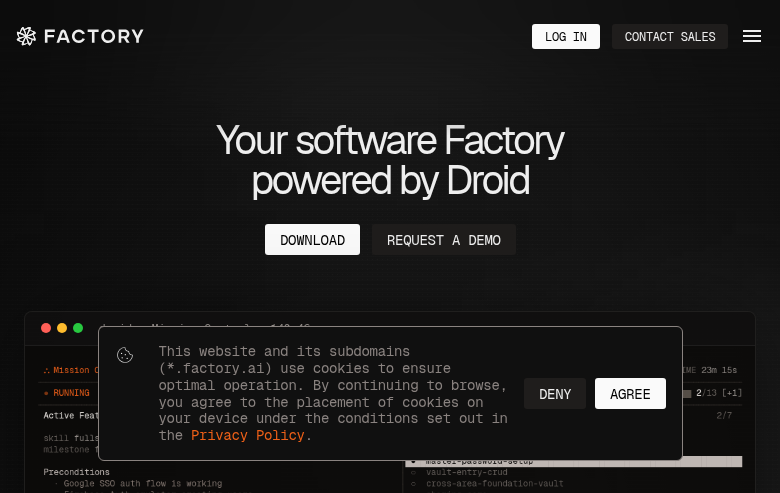
Factory.ai: A Windsurf Alternative for Autonomous End-to-End Software Development with Droids
Factory.ai is an autonomous coding agent platform developed by Factory that uses AI agents called "Droids" to handle software development tasks across Terminal, IDE, Browser, Slack, Jira, and CLI. It operates as a CLI agent platform rather than an IDE — Droids run autonomously in cloud or local background sessions, handling full tasks end-to-end. As a Windsurf alternative, it is best suited for engineering teams that want to delegate complete development tasks to AI agents, rather than using AI for in-IDE pair programming.
Factory.ai vs. Windsurf: Quick Comparison
| Factory.ai | Windsurf | |
|---|---|---|
| Type | Autonomous CLI/desktop agent platform | AI IDE (standalone) |
| IDEs | Desktop app (Mac/Windows/Linux); integrates with Terminal, IDE, Browser, Slack, Jira, CLI | Standalone AI IDE |
| Pricing | Pro from $20/month; higher tiers ~5x and ~10x Pro usage; Enterprise: custom (up to 150 seats) | Not publicly documented |
| Models | Not publicly documented (uses internal Droids architecture) | Cascade (proprietary) |
| Privacy / hosting | Cloud + local background agents; zero data retention option (Enterprise); audit logging available | Not publicly documented |
| Open source | Partial — Factory OSS exists (factory.ai/oss); main Droids platform is closed source | No |
Key Strengths
- Truly autonomous agents — not autocomplete: Factory.ai Droids are not inline code suggestion tools. They operate autonomously across your full development workflow — using Terminal, IDE, Browser, Slack, and Jira to complete tasks end-to-end. This is a fundamentally different model from Windsurf's Cascade, which assists developers interactively in an IDE.
- Multi-platform tool use (Terminal, IDE, Browser, Slack, Jira): Droids can use the same tools a developer uses — they navigate the browser, run terminal commands, interact with Slack, and update Jira tickets. This makes them useful for complex multi-step tasks that span across your development environment, not just code editing.
- Cloud and local background agents with Droid Computers: Factory.ai supports both cloud-hosted agents (Droid Computers — Factory-managed cloud compute) and local background agents. This gives flexibility for teams that want cloud scalability or local execution. Background agents run autonomously while you work on other things.
- Enterprise-grade security with zero data retention option: Enterprise plans include a zero data retention option, SSO/SAML/SCIM, audit logging, and support for up to 150 seats. This is important for teams in regulated industries or with strict data governance requirements.
- Desktop app with clear entry point: Factory.ai has a downloadable desktop app (Mac/Windows/Linux) alongside its cloud interface. Pro plans start at $20/month — one of the more accessible entry price points for autonomous agent platforms. This lowers the barrier to evaluate the platform before committing to enterprise contracts.
Known Limitations
- Enterprise features require a contract: Key enterprise features — zero data retention, SSO/SAML/SCIM, full audit logging, and the 150-seat tier — are only available under an enterprise contract. Teams that need these features cannot self-serve on a lower paid tier. This may slow adoption for security-conscious teams evaluating the platform.
- AI model details not publicly documented: Factory.ai does not publicly document which AI models the Droids use, context window sizes, or model-level specifics. Teams that want to evaluate model quality, compare cost per token, or understand training data policies cannot do so from public documentation alone.
- Less UI-polished than Cursor or Windsurf for in-IDE experience: Factory.ai is optimized for autonomous task delegation, not in-IDE pair programming. Developers who want rich inline suggestions, ghost-text completions, or an IDE-native AI experience will find Factory.ai's interface less polished than Windsurf or Cursor for interactive editing.
- Cloud-first architecture may not suit local-only developers: While local background agents are supported, Factory.ai is primarily a cloud-first platform. Developers who want fully local, offline, or air-gapped AI development workflows will find this limiting. The Droid Computers compute model requires cloud connectivity for that capability.
Best For
Factory.ai is best for engineering teams that want to delegate complete software development tasks to autonomous AI agents rather than use AI for interactive in-IDE assistance. It works well for teams already using Slack and Jira who want their agents to participate in the same workflow — picking up tickets, running code, and posting updates automatically.
Teams building complex, multi-step automation that spans code writing, testing, browsing, and ticket management will benefit most from Factory.ai's Droid architecture. Solo developers or small teams looking for a lightweight AI code editor should evaluate whether autonomous agents match their working style before committing.
Pricing
- Pro: Starting at $20/month (exact credit/usage details on official site)
- Mid tier: ~5x Pro usage pricing (exact price not publicly listed)
- High tier: ~10x Pro usage pricing (exact price not publicly listed)
- Enterprise: Custom pricing — up to 150 seats, SSO/SAML/SCIM, zero data retention, audit logging
Pro starting price verified from official pricing page. Higher tier exact prices not publicly listed as of verification date.
Tech Details
- Type: Autonomous CLI/desktop agent platform
- Platforms: Desktop app (Mac/Windows/Linux) + cloud
- Key features: Autonomous Droid agents, multi-tool use (Terminal, IDE, Browser, Slack, Jira, CLI), cloud background agents (Droid Computers), local background agents, zero data retention (Enterprise), SSO/SAML/SCIM, audit logging, 150-seat Enterprise support, Factory OSS
- Privacy / hosting: Cloud + local background agents; zero data retention option available for Enterprise; audit logging; SSO/SAML/SCIM
- Models / context window: Not publicly documented
- Open source: Factory OSS available at factory.ai/oss; main Droid platform is closed source
Factory.ai's Droid Computers are Factory-managed cloud compute instances that run Droids autonomously. This differs from most AI coding tools that run in-process within an IDE. Droids can operate on long-horizon tasks — running for extended periods, making decisions, and completing multi-step workflows — without requiring a developer to be actively present.
Factory.ai has raised significant VC funding, indicating institutional confidence in the autonomous agent approach. The platform targets enterprise engineering teams looking to scale development capacity through agent delegation rather than developer augmentation.
When to Choose Factory.ai Over Windsurf
- You want to delegate complete development tasks end-to-end to autonomous AI agents — not assist a developer interactively. Factory.ai Droids operate across your full toolchain while you focus elsewhere.
- Your team uses Slack and Jira and wants your AI agents to participate in the same workflow: picking up tickets, posting updates, and running code — without manual copy-pasting between tools.
- You need cloud background agents (Droid Computers) that run autonomously without keeping a terminal session open. Factory.ai's cloud compute for agents is designed for this.
- You require enterprise zero data retention, SSO/SAML/SCIM, and audit logging for AI development workflows. Factory.ai Enterprise provides all of these.
When Windsurf May Be a Better Fit
- You want rich in-IDE AI assistance with inline suggestions, ghost-text completions, and interactive code chat within your editor. Windsurf is purpose-built for this workflow; Factory.ai is optimized for autonomous task delegation.
- You are a solo developer or small team who wants a straightforward AI coding assistant without setting up autonomous agent infrastructure. Windsurf has simpler onboarding for individual developer productivity.
- You need clear public documentation on AI models, context windows, and pricing tiers before committing. Windsurf's model documentation (even if limited) is more developer-facing than Factory.ai's agent-platform framing.
Conclusion
Factory.ai is a strong Windsurf alternative for engineering teams that want autonomous AI agents capable of handling complete development tasks across Terminal, IDE, Browser, Slack, and Jira. Its Droid architecture, enterprise security features, and cloud background agent support make it well-suited for teams looking to scale engineering capacity through AI delegation rather than interactive in-IDE pair programming. Developers who want rich inline code assistance and a polished IDE experience will be better served by Windsurf.
Sources
FAQ
What is a Factory.ai Droid?
A Droid is Factory.ai's autonomous AI agent. Droids use tools the same way a developer would — Terminal, IDE, Browser, Slack, Jira, and CLI. They operate autonomously in background sessions (cloud or local), handling complete development tasks end-to-end without requiring a developer to actively supervise each step.
How does Factory.ai compare to Windsurf?
Windsurf is an AI IDE for interactive in-editor code assistance with inline suggestions and agentic Cascade mode. Factory.ai uses autonomous Droids that operate across your full development toolchain to complete tasks end-to-end. Factory.ai is better for delegating full engineering tasks to AI; Windsurf is better for in-IDE pair programming.
Is Factory.ai free?
Factory.ai does not advertise a free tier. Pro plans start at $20/month. Higher usage tiers and Enterprise plans with SSO/SAML/SCIM and zero data retention require contacting Factory.ai for pricing. A download is available for evaluation.
Does Factory.ai support local agents?
Yes. Factory.ai supports both cloud background agents (Droid Computers — Factory-managed cloud compute) and local background agents. This gives flexibility for teams wanting cloud scalability or local execution. Enterprise zero data retention is available for cloud runs.