Rovo Dev
Contact
Rovo Dev
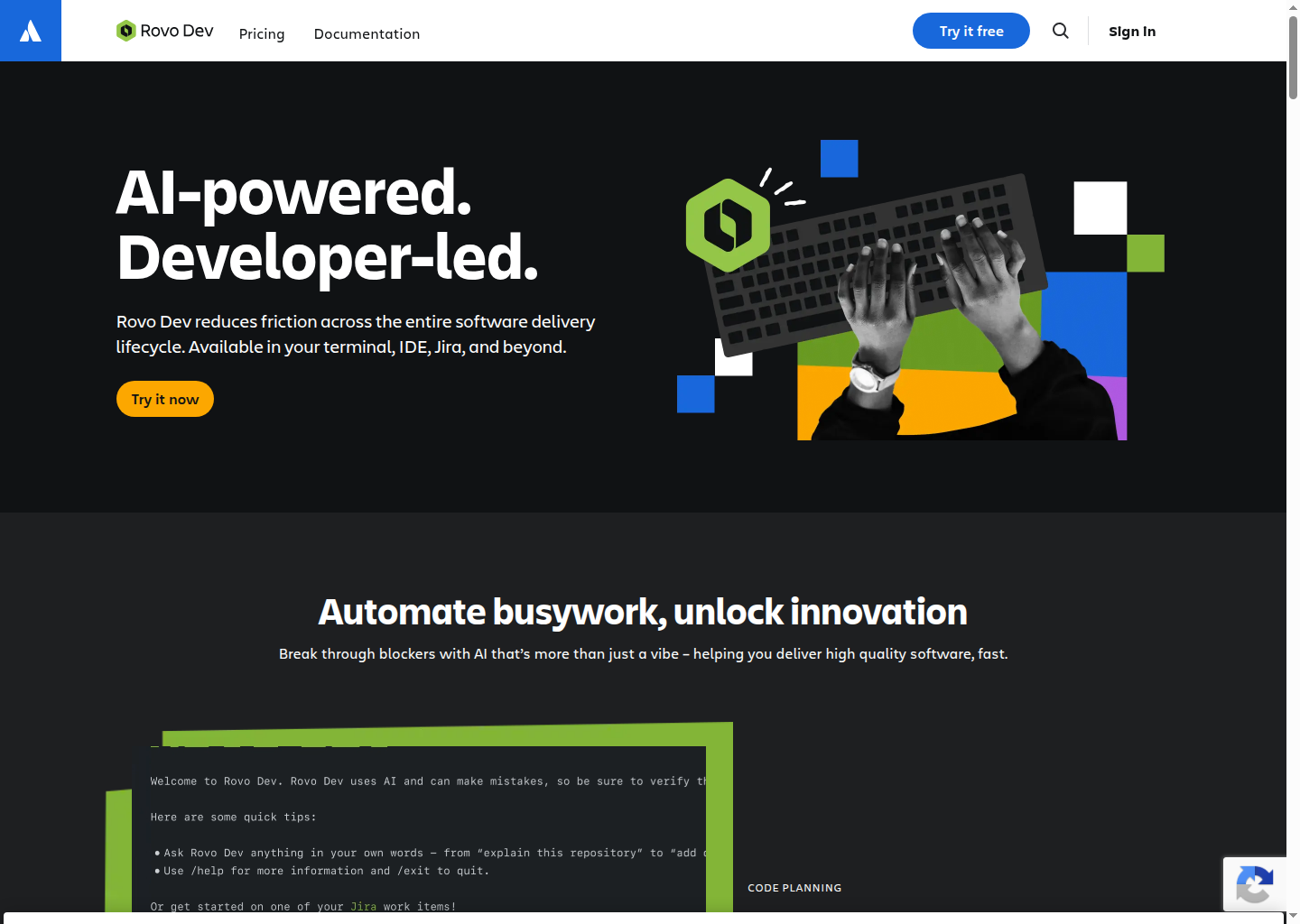
Rovo Dev is Atlassian's AI coding product for software teams that want code generation, review, and SDLC context inside VS Code and Atlassian workflows.
Rovo Dev: A Windsurf Alternative for Teams that want ai coding help connected to jira, confluence, bitbucket, and github context
Rovo Dev is a IDE extension and SDLC coding agent developed by Atlassian. It is positioned around IDE extension with Atlassian-native SDLC context, not just inline code suggestions. As a Windsurf alternative, it is best suited for teams that want AI coding help connected to Jira, Confluence, Bitbucket, and GitHub context.
Rovo Dev vs. Windsurf: Quick Comparison
| Rovo Dev | Windsurf | |
|---|---|---|
| Type | IDE extension with Atlassian-native SDLC context | AI IDE |
| IDEs | VS Code via the Atlassian VS Code extension; Atlassian cloud context across Jira, Confluence, Bitbucket, and GitHub | Standalone editor-centric workflow |
| Pricing | 30-day trial, no permanent free tier, annual plan available; additional usage can be billed at $0.01 per credit after included allocation | Varies by Windsurf plan; verify current official pricing |
| Models | Frontier AI models routed through Atlassian's Teamwork Graph and product context; exact model lineup is not publicly documented | Not fully public in one stable vendor-neutral spec |
| Privacy / hosting | Cloud service that respects existing Atlassian permissions; admins can turn features off and control access | Cloud-oriented editor workflow |
| Open source | No | No |
Key Strengths
- Deep Atlassian context: Rovo Dev is strongest when the code work is tied to Jira issues, Confluence docs, and Bitbucket or GitHub repositories. Atlassian's Teamwork Graph gives it project context that a standalone IDE usually has to reconstruct manually from prompts or local files.
- Workflow coverage beyond editing: The product is designed for the whole software delivery lifecycle rather than only autocomplete or inline chat. Official Atlassian materials emphasize search, chat, edits, tests, and commit preparation, which makes it useful for review-heavy or process-heavy teams.
- Governance for multi-user teams: Permissions inherit from the underlying Atlassian environment, so two developers can see different results based on their access. That matters for companies that treat AI coding as a governed collaboration workflow rather than a solo editor add-on.
Known Limitations
- Atlassian-first product shape: Rovo Dev makes the most sense if your team already lives in Jira, Confluence, and Bitbucket or GitHub. If you want a self-contained editor that does not depend on a broader work-management stack, Windsurf is simpler.
- Pricing is credit-based, not flat-editor simple: Rovo Dev uses credits for interactions and can charge for usage above the included allocation. That is workable for managed teams, but it is less straightforward than a developer-focused flat subscription.
Best For
Rovo Dev is best for software teams that already coordinate work in Atlassian products and want coding assistance to inherit that surrounding context. It fits environments where tickets, documentation, pull requests, and code reviews are tightly connected and where governance matters as much as raw coding speed.
For buyers comparing against Windsurf, the main question is whether they want a product centered on IDE extension with Atlassian-native SDLC context or a more classic AI IDE surface.
Pricing
- Trial: Free 30-day trial for Rovo Dev Standard.
- Standard: No free tier; usage is allocated per user with included monthly credits.
- Overage: Additional usage can be billed at $0.01 per credit after the included monthly allocation.
- Annual plan: Annual billing is available for organizations that want predictable budgets.
Prices are subject to change. Check the official pricing or product documentation for current details.
Tech Details
- Type: IDE extension and SDLC coding agent
- IDEs: VS Code through the Atlassian VS Code extension
- Key features: Context-aware coding, search, chat, edits, tests, commit preparation, PR review
- Privacy / hosting: Cloud service with Atlassian permission model
- Models / context window: Exact model routing and context window are not publicly documented
Rovo Dev is also easier to evaluate when you look at how it handles actual developer workflow boundaries. For example, Rovo Dev focuses on Jira and Confluence context grounding, Bitbucket and GitHub awareness, code edits inside VS Code, pull request review, test execution, commit preparation. That changes the daily experience compared with Windsurf, which is more tightly framed as an AI-native editor.
Another practical consideration is operational fit. A coding tool can look similar in a feature list but feel completely different once you account for code review, ticket context, shell work, provider choices, or governance. That is where these alternatives tend to separate from Windsurf in real teams.
When to Choose This Over Windsurf
- Choose Rovo Dev if your development workflow starts from Jira work items and supporting Confluence docs, not just from local files.
- Choose it when permission-aware collaboration and review workflows matter more than having a standalone AI-native editor.
- Choose it if your team wants one tool that can help with code changes, pull request review, and shipping steps inside an existing Atlassian stack.
When Windsurf May Be a Better Fit
- Windsurf may be a better fit for solo developers who want an editor-first experience with less organizational overhead.
- Windsurf may be better if you do not use Atlassian heavily and want fewer platform dependencies around your coding assistant.
- Windsurf may be better if you prefer simpler per-seat expectations over a credit-oriented usage model.
Practical Workflow Notes
If your team values one-step setup and a unified IDE surface, Windsurf will usually feel faster to pilot. If your team values IDE extension with Atlassian-native SDLC context, the trade-off can be worth it because the product shape aligns better with how work is actually organized.
This matters most on larger repositories and multi-step tasks. In those situations, the winning tool is often the one that matches your workflow boundary conditions, not the one that looks best in a headline benchmark.
That is the real evaluation lens for Rovo Dev. Does it reduce context switching, make approvals easier, preserve enough control, and fit your existing stack? If the answer is yes, it can be a better long-term option than a more generic AI IDE.
Real-World Use Cases
A good way to judge Rovo Dev is to look at concrete tasks instead of generic benchmark claims. For example, developers might use it for repository onboarding, bug triage, test repair, release prep, or cross-file refactors depending on the workflow strengths listed above.
In those situations, Rovo Dev can outperform Windsurf when the surrounding context matters as much as the edit itself. A tool that understands your workflow surface, provider choices, shell steps, or work-management links can save more time than a tool that is only faster at editing one file.
It is also worth testing failure modes. How easy is it to review changes, recover from wrong turns, constrain the agent, and reuse the tool in existing team habits? Those questions usually determine long-term satisfaction more reliably than launch-day excitement.
Adoption Considerations
Before adopting Rovo Dev, teams should check rollout friction, pricing predictability, permission model, and how well the product handles large codebases. That includes verifying whether it works best for solo work, pair-style prompting, review workflows, or background automation.
For buyers comparing several Windsurf alternatives at once, this product is best understood as one point on a spectrum. At one end are polished editor-native products; at the other are configurable terminal or workflow agents. Rovo Dev sits where its product shape and workflow assumptions place it on that spectrum.
Evaluation Checklist
When testing Rovo Dev, start with a realistic repository instead of a toy example. Look at how well it handles reading unfamiliar code, proposing scoped edits, explaining trade-offs, and recovering from a wrong assumption without losing the thread.
Next, test one workflow that includes more than writing code. That could be running commands, reading project docs, reviewing a diff, tracing dependencies, or moving between tickets and implementation details. This is where many apparent alternatives stop looking interchangeable.
Finally, measure how much manual correction the tool creates around the edges. A product can look fast during the first ten minutes and still be expensive if it produces unclear diffs, weak reviewability, or constant context repair work. That practical overhead is often the deciding factor in whether a Windsurf alternative actually sticks.
Long-Term Fit
The most durable AI coding tools are the ones teams can trust under repetition. That means predictable behavior across large repositories, understandable diffs, sensible defaults for risky actions, and enough transparency that developers do not feel they are guessing what the agent will do next.
Rovo Dev should therefore be judged not only by feature breadth but by operational fit over weeks of usage. If it regularly reduces handoff time, review time, and context rebuilding, it is doing more than just accelerating edits. It is improving how development work flows through the team.
Conclusion
Rovo Dev is a serious Windsurf competitor for teams that care about project context, governance, and delivery workflow more than pure editor identity. If your software process already runs through Atlassian, it can be a stronger operational fit than a standalone AI IDE.
Sources
FAQ
Is Rovo Dev free?
Not as a permanent free tier. Atlassian offers a 30-day trial, but the official pricing page says there is no free tier and that usage is credit-based.
Does Rovo Dev work with VS Code?
Yes. Atlassian says Rovo Dev is generally available in Visual Studio Code through the Atlassian VS Code extension.
How does Rovo Dev compare to Windsurf?
Rovo Dev is more workflow- and context-driven for teams using Jira, Confluence, Bitbucket, and GitHub. Windsurf is more editor-centric and easier to evaluate as a standalone coding environment.
Who should choose Rovo Dev over Windsurf?
Teams that want permission-aware AI help tied directly to work items, documentation, reviews, and delivery processes should look at Rovo Dev first.